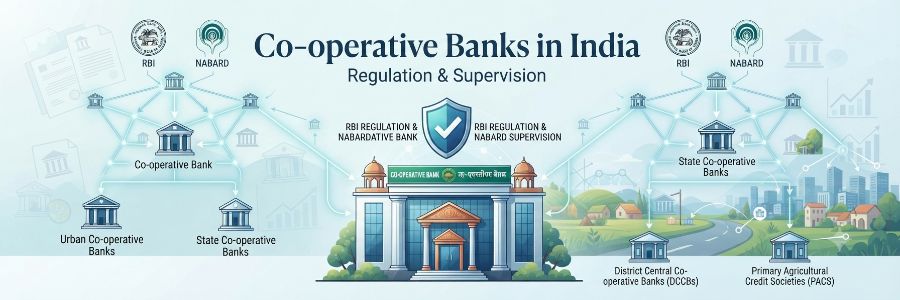
Co-operative banks are institutions of finance that are founded upon cooperation, mutual assistance and active participation of their members. The role of co-operative banks in providing banking and credit facilities to communities, small-scale enterprises and rural areas has been a traditional one.
This kind of institution is based on such principles as democratic member control, openness of membership and voluntary association and equality of voting rights in case of primary co-operatives. These institutions aim at fulfilling the common needs of their members without any necessity for the goal of maximizing profits.
Nevertheless, co-operative banks should conform to laws and regulations that are applied to their category. The legislation on co-operative societies in India differs from that of banking. The regulation of banking activities is carried out according to the Banking Regulation Act, 1949 whereas cooperative and administrative affairs are covered by cooperative legislation.

Main Characteristics of Co-operative Banks
Customer-Owned Institutions
The members of a cooperative bank are usually both the owner and the customer of that bank. The main purpose of a cooperative bank is not just the maximization of profits but rather to serve the interest of the member customers. There are some cooperative banks which offer banking services even to non-members.
Democratic Member Control
In accordance with the co-operative principle of "one member one vote," it usually implies that each member has one vote, regardless of the number of shares held. Such a principle is meant to facilitate democracy and ensure that voting power is not dependent on the share of stocks owned by a member. However, the actual voting process is guided by relevant legislation of both cooperatives and banks.
Allocation of Profits
The specific part of the profits is to be transferred to statutory as well as other reserves according to the provisions of the relevant laws. The interest may be charged against the capital subscribed by the members, while a certain part of the profits can be divided among the members according to the relevant laws.
Financial Inclusion in Rural Areas
Co-operative credit organizations have been vital in providing financial services in rural settings, even in places where there is no access to traditional banking. The nature of the co-operative credit organizations may assist in catering to the credit requirements of the rural people, farmers, and small borrowers. However, the effectiveness varies from organization to organization.
Co-operative Credit Societies and Co-operative Banks: The Legal Difference
There is an important difference made in the Seventh Schedule of the Constitution of India regarding the areas of co-operative societies and banking. The former comes under Entry 32 of the State List whereas the latter comes under Entry 45 of the Union List.
This is significant for the reason that both co-operative societies and co-operative banks can be regulated differently under the law. While co-operative societies are regulated through the co-operative law and the banking activities of licensed co-operative banks are regulated by the RBI under Banking Regulation Act, 1949.
It should be noted that all co-operative societies are not banks and all co-operative credit societies are not authorized to accept public deposits. This can happen only after fulfillment of certain statutory requirements.
Structure of Co-operative Credit Institutions in India
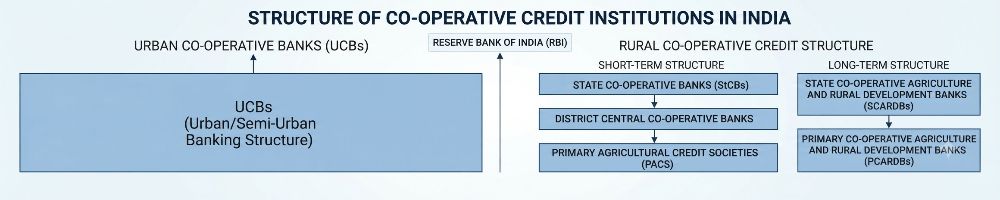
Credit co-operatives may generally be categorized into urban and rural credit co-operatives.
Urban Co-operative Banks
Urban Co-operative Banks are banks that provide their banking services mainly in urban and semi-urban areas. Urban co-operative banks can either be registered under the relevant State Co-operative Societies Act or Multi-State Co-operative Societies Act, 2002, if they are multi-state co-operative societies. Urban Co-operative Banks engaged in banking activities are also bound by the relevant provisions of Banking Regulation Act, 1949.
UCBs are categorized in four different levels according to their deposit amount and region.
|
Tier |
Deposit-size classification |
|
Tier 1 |
All unit UCBs and salary-earners’ UCBs, irrespective of deposit size and all other UCBs with deposits up to ₹100 crore |
|
Tier 2 |
UCBs with deposits above ₹100 crore and up to ₹1,000 crore |
|
Tier 3 |
UCBs with deposits above ₹1,000 crore and up to ₹10,000 crore |
|
Tier 4 |
UCBs with deposits above ₹10,000 crore |
Rural Co-operative Credit Institutions
Rural co-operative credit institutions are broadly divided into short-term and long-term co-operative credit structures.
The short-term structure has three levels:
|
Level |
Institution |
Main role |
|
State level |
State Co-operative Banks (SCBs or StCBs) |
Apex banks that coordinate, refinance, and support DCCBs in a state |
|
District level |
District Central Co-operative Banks (DCCBs) |
Middle-tier banks linking PACS with the state-level bank and providing credit |
|
Village level |
Primary Agricultural Credit Societies (PACS) |
Provide short-term loans and services directly to farmers and rural members |
The long-term structure has two levels:
|
Level |
Institution |
Role |
|
State / apex level |
State Co-operative Agriculture and Rural Development Banks (SCARDBs) |
Apex long-term lending institutions operating at the state level, where this system exists |
|
Primary level |
Primary Co-operative Agriculture and Rural Development Banks (PCARDBs) |
Provide long-term credit directly at the district, taluka, or block level, depending on the state |
Note : The short-term co-operative credit system emphasizes short-term agricultural credit requirements, whereas the long-term co-operative credit system is concerned with the financing of agriculture and rural development in the long run.
Regulation of Different Co-operative Institutions
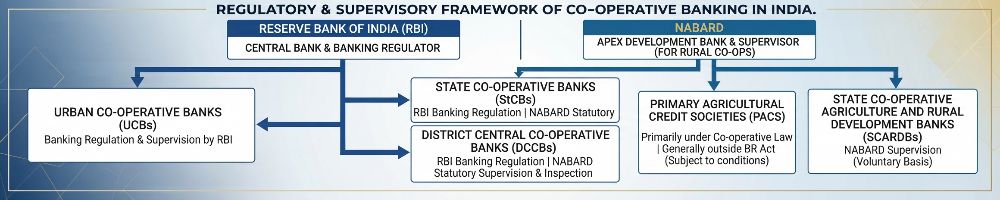
The regulatory and supervisory system varies from one category of co-operative institution to another. The RBI regulates and supervises the banking operations of UCBs. The StCBs and DCCBs come under RBI’s banking regulation but are subject to statutory supervision and inspection by NABARD.
The PACS are normally exempted from the ambit of Banking Regulation Act, 1949, subject to statutory requirements for them. Their cooperative and administrative affairs are regulated by appropriate co-operative laws. The long term rural co-operative credit institutions, namely, SCARDBs and PCARDBs are not regulated under the Banking Regulation Act, 1949, and come under the rural credit institutions regulated by NABARD.
These are some of the differences in respect of co-operative institutions in terms of legal framework applicable to them. The applicable legal framework is dependent on the legal status of the institution, its banking activities and the relevant co-operative law and its amendments.
Supervision of Urban Co-operative Banks
The supervisory framework for UCBs consists of on-site inspection and off-site surveillance.
On-site inspection: As per the provisions of the Banking Regulation Act, 1949, the RBI is empowered to carry out inspections under Section 35. Historically speaking, the RBI has always followed the CAMELS approach in conducting its examinations. The acronym CAMELS denotes Capital Adequacy, Asset Quality, Management, Earnings, Liquidity, and Systems and Controls. Nonetheless, the latest supervisory framework and methodology of assessment have to be checked before claiming that the RBI follows the CAMELS approach in its entirety.
Off-site Surveillance: The UCBs are mandated by the RBI to submit periodic supervisory and regulatory returns to it. The data submitted serves as a basis for prudential supervision. Through the submission of these returns, the RBI is able to keep a tab on the financial health of the UCBs outside of on-site supervision.
Supervisory Action Framework for UCBs
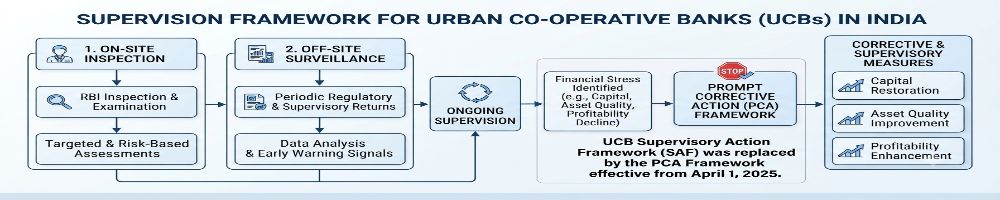
There have been changes in the supervisory framework of financially troubled UCBs over time. The earlier Supervisory Action Framework (SAF) has been replaced by Prompt Corrective Action (PCA) Framework since April 1, 2025.
As per the present PCA framework, capital adequacy, asset quality, and profitability are some of the important aspects. Depending upon the seriousness of the problem, the RBI may take appropriate actions like putting a restriction on expansion of business, capital expenditure, dividend payment, and risk exposure.
Measures taken under the previous SAF framework include restrictions on opening of new branches, capital expenditure, payment of dividends, and advance growth. Measures need to be seen in the context of the previous SAF framework only.
Where there is serious financial stress in an UCB, the same may be put under All Inclusive Directions (AID) as per section 35A read with section 56 of Banking Regulation Act, 1949. Restrictions may be imposed on receiving fresh deposits, giving fresh loans, and withdrawing /repayment of deposits. UCBs under AIDs continue to be under the supervisory radar and undergo restructuring/other remedial measures including mergers where ever possible.
In Short
Co-operative banks and credit institutions are significant players in extending financial services to the members, farmers, small borrowers, and rural population segments. There is variation in their structure and regulation depending on the types of co-operative organizations. RBI and NABARD have different roles in regulating and supervising the co-operative organizations.
Login with