
Commercial banks are under certain restrictions to protect the banks’ depositors, to ensure the banks’ financial security, and to maintain stability in the banking system. The regulations account for several key areas that are vitally important for the banks’ proper functioning and are under the special control of the banking regulator.
Prudential Norms
Prudential standards are norms set up by bank regulators i.e RBI in India to ensure that the operations of banks are conducted safely and prudently. Prudential norms are concerned with issues like accounting practices, income recognition, asset classifications, loss provisioning, and management of capital. Prudential standards play an important role in helping banks discover their weaknesses and recognise their losses on time.
Income Recognition, Asset Classification and Provisioning Norms (IRACP)
IRACP rules help measure the quality of advances made by a bank, especially its loans and credit facilities. Banks provide loans and advances to various categories of borrowers. At times, there is likelihood that some borrowers do not pay back the advances because of an economic recession or even difficulties experienced by the borrower. Such facilities which are not settled beyond the stipulated period are usually NPAs (non-performing assets). In India, a loan is classified as a Non-Performing Asset (NPA) if the borrower fails to pay the principal or interest for more than 90 days.
This norms provide a rough framework that guides the banks on how to book their gains on advances, categorization of the loan accounts and probable losses provisions. This aids in giving a better picture of the bank's financials and probable losses.
Basel Guidelines on Capital and Liquidity
Basel guidelines are internationally accepted standards that regulate the activities of banks, especially as regards capital adequacy and risk management. In the risk-based capital guidelines, banks have to keep capital in relation to the risks posed by their assets and activities.

Banks facing higher risks need to maintain more capital to absorb potential losses. While capital ratios make the banks better positioned to handle losses, liquidity ratios ensure that the banks have enough funds to meet their liabilities whenever they fall due. As such, the Basel Capital Adequacy guidelines establish the connection between capital ratios and the risk of the banks’ exposures.
Exposure Norms
Exposure norms help banks avoid putting too much money at risk with one borrower. RBI prescribes limits on a bank's credit exposure to an individual borrower and to a related pool of borrowers. A bank having excessive exposure to a single borrower or to a related set of borrowers will stand to lose heavily on account of the financial difficulties of such a borrower or set of borrowers. The limits on exposures prevent excessive concentrations of risk to any one borrower or related borrowers and promote diversification and prudence in lending.
Investment Guidelines
Securities and other investments in permissible instruments are made by banks in the course of their business operations. The RBI investment portfolio system classifies investments in three groups:
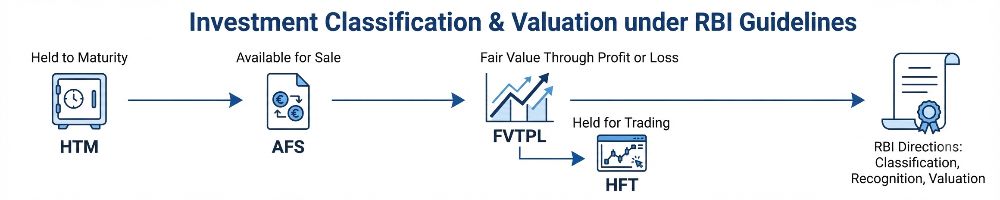
Held to Maturity (HTM): Investments falling under this group are those which are intended to be held to maturity as per the regulatory requirement.
Available for Sale (AFS): Investments in this category are neither categorized as HTM nor as HFT investments and can be sold whenever it is necessary.
Fair Value Through Profit or Loss (FVTPL): Investments in this category are valued at fair value, with any gains or losses from changes in value recognised in the profit or loss.
Held for Trading (HFT): The investments in this group are those intended to be traded and profited through the changes in their prices.it is subcategory under FVTPL
Classification, recognition and valuation of such investment groups have been prescribed by RBI directions. As the requirements pertaining to them can be modified at any point of time, the RBI instructions need to be considered while giving details on the accounting and valuation aspects.
Resolution of Stressed Assets
A stressed asset refers to a loan or any other financial instrument which faces an increased risk of default in repayment or shows other signs of deterioration in its ability to repay. A stressed asset has the potential to turn into a non-performing asset (NPA) and may require corrective action to prevent it from becoming an NPA.
The Banking Regulation (Amendment) Act, 2017 empowered the Reserve Bank of India (RBI) to issue directions to the banks regarding resolution of stressed assets, including directions relating to proceedings under the Insolvency and Bankruptcy Code, 2016 (IBC) The objective of resolution of stressed-asset is to tackle repayment problems in a time bound manner, enhance recovery and avert further build-up of bad loans in the system.
Regulation of Interest Rates
Interest rates affect deposit earnings, borrowing costs and the demand for loans. Interest rate regulation falls within the wide umbrella of banking regulation. The level of regulation depends on the type of interest rate, the financial product and the applicable RBI guidelines. Consequently, it is wrong to assume that all interest rates for borrowings and deposits are controlled by the RBI.
Know Your Customer Norms (KYC)
KYC guidelines help banks identify and verify their customers. KYC helps in preventing any activity that may include money laundering, identity theft, fraud, and other prohibited actions in the banking system. Banks must follow guidelines for customer identification, verification and record-keeping. This is dependent on the KYC guidelines at a given time and the type of customer relationship.
Corporate Governance
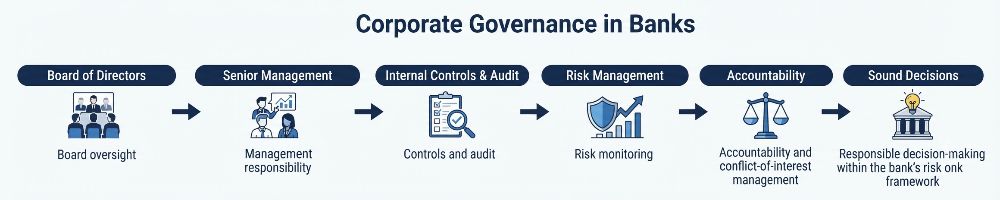
Corporate governance is a means by which the bank is governed. It encompasses such issues as the obligations of the board of directors, senior management, internal controls, and auditing. Good corporate governance will ensure proper accountability and handling of conflicts of interests and ensure that important decisions are made within the bank’s risk management structure.
Disclosure Norms
Disclosure requirements improve transparency by requiring banks to report important information about their financial position and performance.The details may range from capital adequacy, quality and liquidity of assets, income statement, and regulatory sanctions, among others, as required by the disclosure requirements in the annual reports and other regulatory reports.These requirements help depositors, investors, analysts and other stakeholders understand a bank’s financial position, risks and performance.
Deposit Insurance
Insurance of the deposit is meant to protect the eligible depositors against the loss of their insured deposits due to failure of the insured bank according to the rules. The maximum insurance cover offered by the DICGC (subsidiary of RBI) for each eligible depositor in respect of the deposits held by him in the same right and capacity with a bank shall be ₹5 lakhs, comprising principal and interest, according to the applicable rules. Insurance of the deposit offers the depositor a certain level of protection.
Para-Banking Activities
Para-banking refers to financial activities aside from the traditional deposit-taking and lending activities that take place in the banks. The activities that a bank can engage in determine the permissions, directions and conditions the RBI imposes on it. Banks must ensure that their activities comply with the applicable rules and guidelines.
Regulation of All India Financial Institutions (AIFI)
All India Financial Institutions (AIFIs) function within the legal framework set up for each institution. The regulations are framed under the laws that govern each institution and provisions of the Reserve Bank of India Act, 1934. The requirements of regulation differ according to the institutions and the laws under which they function.
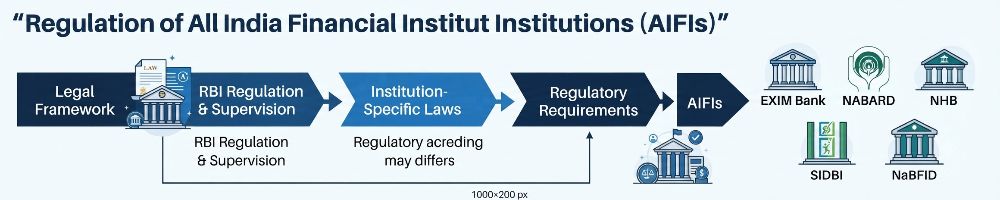
Some Major AIFI as follow :
- EXIM Bank
- NABARD
- NHB
- SIDBI
- NaBFID
Credit Information Companies
Credit Information Companies obtain, process, and distribute credit-based information to authorised persons for provision of credit reports and other related services. The statutory regime comprises the
Credit Information Companies (Regulation) Act, 2005
Credit Information Companies Rules, 2006 and
Credit Information Companies Regulations, 2006.
Credit-based information assists lenders in evaluating the credit history of a potential borrower in order to make an informed lending decision. Such information must be collected, processed, shared and used in accordance with the applicable laws.
Login with