
The Reserve Bank of India (RBI) is India’s central bank, which performs essential functions for the country’s financial and monetary system. First of all, the central bank differs from the commercial bank in several aspects, including functions, objectives, and powers. The central bank manages and regulates the key elements of the monetary system, oversees financial institutions in accordance with the laws, ensures the smooth functioning of payment mechanisms, and acts as banker to the government and commercial banks.
The central bank was formed to regulate currency and monetary issues, provide banking services, and promote financial and economic stability. Sveriges Riksbank was the first central bank in the world, founded in 1668. The Bank of England was the second to open in 1694, and the US Federal Reserve System in November 1914. The Reserve Bank of India began its work on April 1, 1935.
Central Bank and Commercial Banks
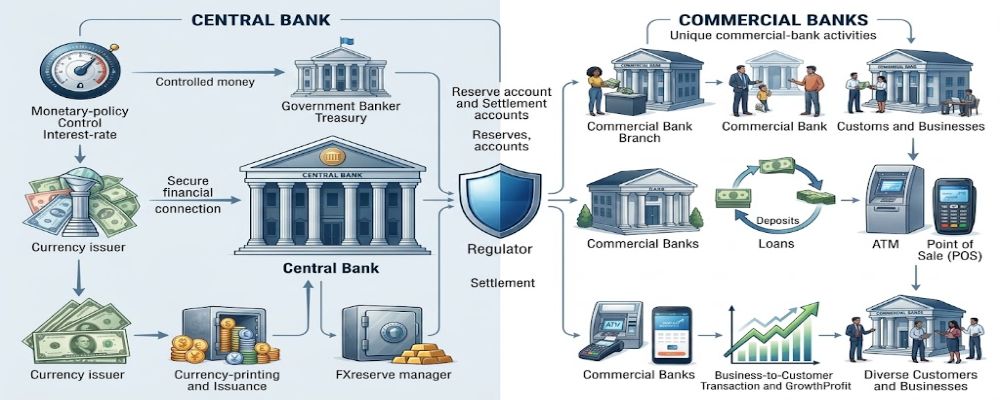
Central Bank is the apex body of the country's monetary system. Banks provide financial services to individuals, companies, and other customers and are regulated according to the regulations laid down by the competent authorities.
The central bank affects the availability and cost of money via monetary policy and other policies, while commercial banks extend loans and create deposits via their lending operations. Central banks act as bankers to the government, and in India, they have the power to print banknotes except for the one rupee note that is printed by the Government of India.
Banks normally operate as commercial enterprises and try to make profits within regulatory framework. Central banks have broader monetary, regulatory and policy functions. Central banks are responsible for managing the foreign exchange reserves of India under their statutory powers, while commercial banks are not entrusted with the task of managing foreign exchange reserves of India.
History and Evolution of the RBI
Several important events characterized the evolution of India’s central banking system.

The Royal Commission on Indian Currency and Finance suggested setting up a central bank for India in 1926. The bill that was aimed at this suggestion was presented in the Legislative Assembly in 1927 but was later withdrawn because it failed to come to an agreement between the parties involved.
The White Paper on Indian Constitutional Reforms made a recommendation on the creation of a Reserve Bank in 1933, and a new bill was introduced. The Reserve Bank of India Bill was adopted in 1934 and received the assent of the Governor-General.
The RBI started its work in 1935 as a privately owned shareholders’ bank with the paid-up capital of ₹5 crore, which amounted to ₹50 million at the time. Burma separated from India in 1937, but the RBI continued to act as the central bank for Burma until April 1947. It stopped providing central banking facilities to Pakistan on 1948. The RBI was nationalized by the Government of India in 1949 through the Reserve Bank (Transfer to Public Ownership) Act, 1948.
Central Board of Directors of RBI
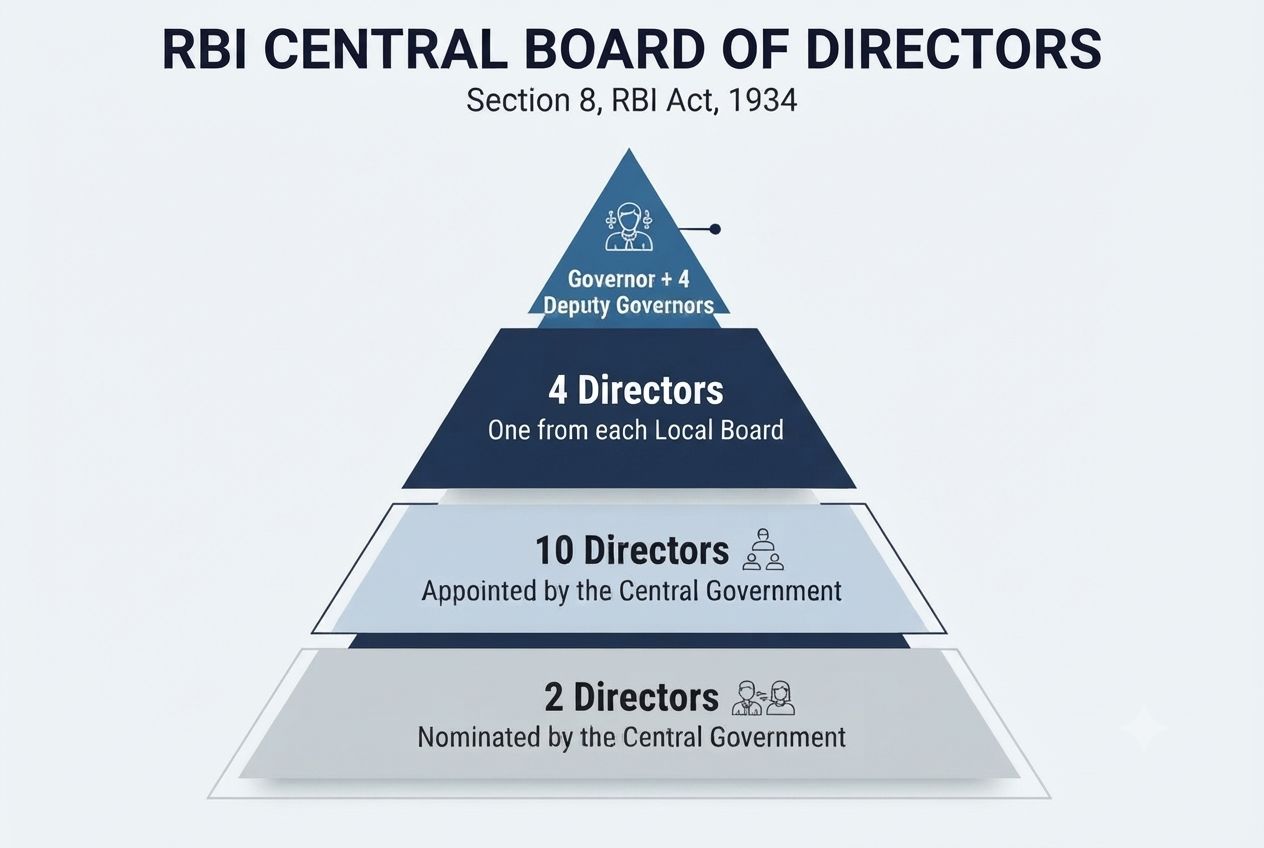
The RBI operates under the Central Board of Directors as per Section 8 of the RBI Act of 1934.
The Central Board includes the following members :
Governance and Committees of the RBI
The Central Board of Directors is the primary governing body of the RBI. These committees include a committee and sub-committees that work on issues related to financial supervision, payments systems, audit, risk management, human resources, building, and IT and strategic issues and These committees have the Governor at their head.
The three important committees of the Central Board are as follows:
- Committee of the Central Board (CCB)
- Board for Financial Supervision (BFS)
- Board for Regulation and Supervision of Payment and Settlement Systems (BPSS)
1. Committee of the Central Board (CCB)
The Committee of the Central Board (CCB) is a committee of the Reserve Bank of India. It works as per the provisions of the Central Board, and its purpose is to deal with the present business of the Reserve Bank. The Committee of the Central Board is presided over by the Governor of the RBI, and it normally holds one meeting every week. This Committee is important because it deals with the day-to-day business of the Reserve Bank.
In simple words, the Committee of the Central Board assists the Central Board in dealing with the present business of the Reserve Bank.
2. Board for Financial Supervision(BFS)
The BFS was formed in November 1994 as a committee of the Central Board of the Reserve Bank of India in terms of the Reserve Bank of India (Board for Financial Supervision) Regulations, 1994. It was constituted with a view to ensuring dedicated and integrated supervision of the financial sector within the jurisdiction of the RBI.
The Chair of the BFS is the Governor of RBI, and the Deputy Governors of the Reserve Bank of India are ex-officio members of the committee. One of the Deputy Governors of the RBI, generally in charge of banking regulation and supervision, is appointed as Vice-Chairman of the BFS. Four Directors of the RBI Central Board are co-opted as members, for a period of two years.
A sub-committee of the BFS was also constituted with a view to enhancing the effectiveness of statutory and internal audit functions in banks and financial institutions. The Chairman of this sub-committee was the Deputy Governor of RBI, and two directors of the RBI Central Board were members of the sub-committee.
3. Board for Regulation and Supervision of Payment and Settlement Systems
This was formed in March 2005 under BPSS Regulations, 2005. It is a body set up by the Central Board of the Reserve Bank of India for regulation and supervision of the payment and settlement systems in India. The BPSS is headed by the Governor of the RBI. It formulates policies, prescribes standards, approves payment systems and operators, and ensures that the system operates safely and efficiently. The Department of Payment and Settlement Systems (DPSS) helps the BPSS in discharging its responsibilities.
The Central Board has five sub-committees:
- Audit and Risk Management Sub-Committee (ARMS)
- Human Resource Management Sub-Committee (HRM-SC)
- Building Sub-Committee (B-SC)
- Information Technology Sub-Committee (IT-SC)
- Strategy Sub-Committee (S-SC)
RBI Subsidiaries and Related Institutions
1. Deposit Insurance and Credit Guarantee Corporation (DICGC)
DICGC grants insurance coverage to eligible depositors of insured banks. It covers deposits like savings, fixed, current and recurring deposits. The amount of deposit insurance is limited to ₹5 lakh for a depositor, for the time being. This applies to deposits of the same right and same capacity made with the same bank. The deposits held by a depositor in different branches of a bank are combined for the purpose of determining the limit.
The deposits of foreign governments, Central and State Governments, inter-bank deposits, deposits received outside India, and such others as may be specifically exempted by DICGC, subject to the approval of the Reserve Bank, are excluded from deposit insurance coverage.
2. Bharatiya Reserve Bank Note Mudran Private Limited (BRBNMPL)
It is a subsidiary owned by RBI established on February 1995, with an aim to enhance the production of banknotes and bridge the gap between demand and supply of banknotes. BRBNMPL has two banknote presses in Mysuru, Karnataka, and Salboni, West Bengal. Additionally, the Government of India owns two other presses through SPMCIL in Nashik, Maharashtra, and Dewas, Madhya Pradesh. Moreover, there are four other mints authorized to produce coins by the government which are located in Mumbai, Hyderabad, Kolkata, and Noida.

Security Printing and Minting Corporation of India Limited (SPMCIL)
It is Security Printing and Minting Corporation of India Limited (SPMCIL) is a wholly owned Schedule A, Miniratna Category-I company of the Government of India. It was incorporated on 13 January 2006. The management, control, maintenance and operations of nine former production units were transferred to SPMCIL with effect from 10 February 2006. It functions under the administrative control of the Ministry of Finance through its Board of Directors.
SPMCIL is engaged in the production of currency and banknotes, security paper, non-judicial stamp papers, postal stamps and stationery, passports and visas, security documents, cheques, bonds, security inks, circulation and commemorative coins, and medallions. It also undertakes refining of gold and silver and assaying of precious metals.
3. Reserve Bank Information Technology Private Limited (ReBIT)
It was created by the Reserve Bank of India in 2016 to provide IT and cybersecurity services to the banks and other entities subject to regulation by the central bank. The main objective of ReBIT is to promote and improve the IT infrastructure and cybersecurity capabilities within the financial sector while supporting the cyber resilience, systems audit, research, and technological development functions.
4. Indian Financial Technology and Allied Services (IFTAS)
IFTAS was established in 2015, is an independent subsidiary of RBI that provides important technological infrastructure and IT services on 24×7 basis to the banking and financial industry. IFTAS assumed INFINET, SFMS and IBCC services from IDRBT. INFINET offers communication connectivity services, SFMS offers secure financial messaging services, and IBCC offers cloud services to the banking and financial sector.
5. Reserve Bank Innovation Hub
It was formed by the RBI as its wholly-owned subsidiary in order to foster innovation within the financial sector. It was incorporated as Section 8 company under the provisions of Companies Act, 2013 with the initial capital infusion of ₹100 crore. The registered office of RBIH is situated in Bengaluru. RBIH was launched by RBI Governor Shaktikanta Das on March 2022 in Bengaluru.
Some of the goals of RBIH include fostering an environment for financial innovations, promoting the usage of financial services and products and building capacity in FinTech research and emerging technologies. RBIH works with financial institutions, technology firms, industries and educational institutions in the area of exchanging ideas and developing prototypes for financial innovations.
RBI as Banker to Banks
The RBI offers banking and liquidity facilities to eligible banks and financial institutions. The types of loans, advances, and bill discounting transactions that the RBI is authorized to do are mentioned in Section 17 of the RBI Act of 1934. Section 42 mentions the requirement for keeping cash reserves in relation to scheduled banks with the RBI.
Banks have access to various forms of liquidity facility such as Repo, Term Repo, and MSF provided the conditions and collateral requirements are fulfilled. Primary Dealers have access to certain liquidity facilities as well.
RBI as Banker to the Government
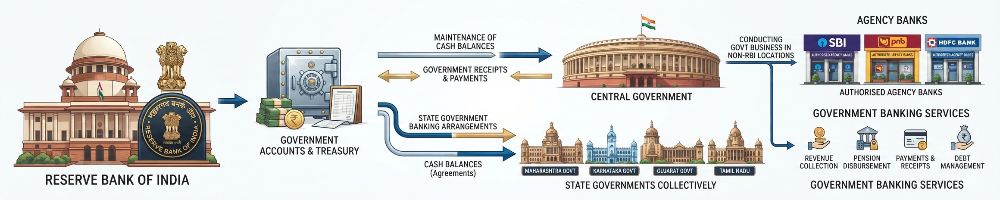
RBI is the banker to the Central Government and State Governments by agreement. The banking business of RBI for the Central Government and State Governments is covered under sections 20 & 21 of RBI Act, 1934. Banking business for State Government through agreement with State Government is done by RBI under section 21A.
Through agency banks, RBI conducts government banking business in places where RBI does not maintain its branches. Cash balances of Central Government are kept with RBI to a certain minimum level of agreement. Similarly, the cash balances of State Governments are also kept with RBI through mutual agreements.
Current Accounts and Special-Purpose Accounts
Eligible banks and financial institutions have permission to hold current accounts with the RBI. This includes commercial banks, Regional Rural Banks, Local Area Banks, co-operative banks, State Land Development Banks, Primary Dealers, Indian financial institutions, insurance companies, mutual funds, foreign central banks, supranational organizations, and other institutions authorized by the RBI.
The opening of current accounts is done through the E-Kuber Core Banking Solution facility in the relevant RBI Regional Office. The accounts are used for purposes like maintaining CRR, money transfer between institutions, inter-bank settlements, and payment to the RBI and government departments.
There can be special purpose accounts held with the RBI such as Line of Credit, SBI DD/TT Payable, and CCIL Multi Modal Accounts. Settlement accounts are maintained by banks for RTGS. As per Section 17(13) of the RBI Act, 1934, the RBI can act as the correspondent/agent of banks and institutions incorporated outside India and can hold rupee accounts for them.
Public Debt Management
The Reserve Bank is responsible for the public debt and cash management of the Central Government as per Section 20 and Section 21 of the RBI Act, 1934. As per Section 21A, the Reserve Bank can manage the public debt of the State Government on behalf of that government as per an agreement.
The Internal Debt Management Department (IDMD) is responsible for the Market Borrowing Program of the Central Government and coordinating the market borrowing programs of State Governments and UTs. The Government Securities Act, 2006, together with Government Securities Regulations, 2007, formulates the legal basis for the issuance of government securities.
Consolidated Sinking Fund and Guarantee Redemption Fund
The Consolidated Sinking Fund (CSF) is a reserve fund held by some State Governments with the RBI to act as a buffer against repayment/amortisation of their borrowings/ liabilities in the market. The Guarantee Redemption Fund (GRF) is also kept as a reserve fund to act as a buffer against contingent liabilities that arise out of guarantees. In the case of Union Government, a Guarantee Redemption Fund is provided under the Public Account of India for redemption of guarantees provided to Central Public Sector Enterprises, financial institutions, etc., if and when guarantees are called upon.
Login with