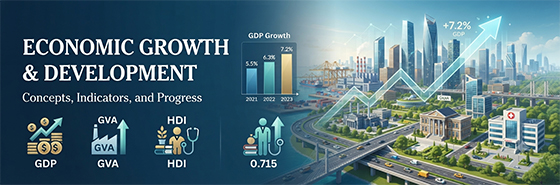
Economics Made Simple: Basic Concepts, Systems, Sectors and GDP
Economics appears to be complex with jargons such as GDP, inflation, national income, HDI, macroeconomics, etc. But economics can be simplified to basic elements of choices involving scarce resources. Our needs are greater than the available money and time which are scarce resources. The student chooses how to allocate his/her pocket money. The firm decides where to allocate its investment. The government decides how to allocate its budgetary allocations. In this way, economics is choice-making which is not limited to any person, firm, or even the government. Economics is about choice, resources, production, consumption, income, and welfare of society.
What Is Economics?
Economics is concerned with the allocation of scarce resources. Land, labour, capital, raw materials, and time are some of the scarce resources. Our wants are unlimited. Our wants exceed our available resources; hence, we need to make a decision on how to allocate our scarce resources to fulfill our unlimited wants. For instance, a student has ₹1,000 with which he intends to purchase books, shirts, and earphones. However, he cannot purchase all three things at once and thus needs to make a choice. Economics consists of three basic questions: What to produce? How to produce? For whom to produce?
Economics is broken down into two main categories: microeconomics and macroeconomics.
Microeconomics:
Microeconomics deals with minor elements in economics like the consumer, firm, and labor. For instance, if the cost of petrol increases, then microeconomics enables us to analyze how the consumer will alter his consumption pattern and how the firms will have to bear additional expenses for transportation purposes.
Macroeconomics:
The study of macroeconomics includes the entire economy, such as the country’s income level, economic growth, inflation, unemployment rate, and total production. Macroeconomic variables of interest to the government include interest rate, budget deficit, and the balance of payments position. For instance, if the rate of inflation increases, we may use macroeconomics to determine the reasons behind the increase and its effects on individuals and firms.
Main Factors of Production:

Every product requires some kind of resources for its manufacture. There are four types of resources.
Land : Land consists of all kinds of lands and natural resources like farm lands, minerals, and water. Rent is the return from land.
Labour : Labour means human efforts in both mental and physical form. Examples of labour are unskilled labourers, skilled labourers, engineers, teachers and drivers. Wages is the return from labour.
Capital : Capital is the man-made resources which help in manufacturing goods and providing services. Examples of capital are machines, factories and equipments. Interest is the return from capital.
Entrepreneurship : The entrepreneur is the person who owns and controls the other three types of resources. He takes risks to earn profits. For instance, an industrialist who has a factory uses land, labour and machines to manufacture goods. Profit is the return from entrepreneurship.
Who Take Part in an Economy?
Households : These are individuals who consume goods and services. Households also contribute to the economy through labor.
Businesses : Firms that create goods and services form businesses. Businesses use labor and acquire raw materials from the suppliers.
Government : This is an entity in charge of taxation, regulation of businesses, provision of public goods and services, and regulation of public good such as roads. Fiscal policy of the government and monetary policy of the central bank play important roles in the economy.
External Sector : Not any country is operating in isolation today. Especially when considering globalization, no country is able to operate in isolation today. For this reason, there is buying and selling of goods and services between countries. Also, there are capital movements across nations. (Note) : Export and imports fall into the category of external sectors. So do capital flows.
Types of Economic Systems
Traditional Economy : The traditional economy is an economy run by tradition, customs, and religion. It is an economy that uses subsistence agriculture and other traditional methods.
Command Economy : Command economy is an economy run by the government; the government makes all the decisions.
Market Economy : Market economy is run by the consumers and businesspersons. All the decisions are made on the basis of demand, supply, and market prices.
Mixed Economy : Mixed economy is a system that combines elements of all three economies. In India, we have a mixed economy.
Primary, Secondary and Service Sectors
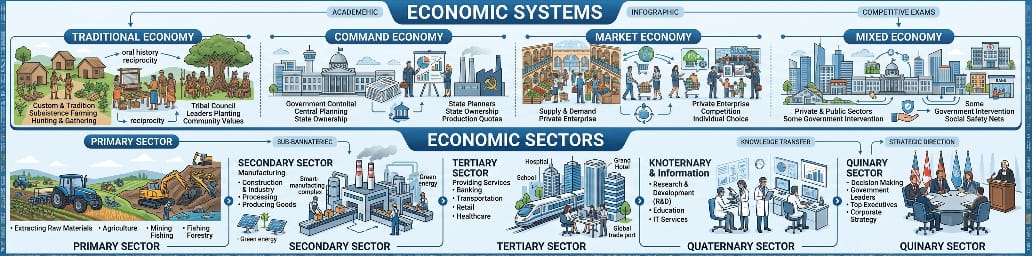
Primary Sector : The primary sector is associated with the extraction of natural resources. The primary sector is responsible for producing food, raw materials and other products to support the secondary sector. Examples of the primary sector include farming, fishing, hunting, forestry and mining.
Secondary Sector : The secondary sector is related to processing and manufacturing activities. Examples of the secondary sector include steel plants, flour mills and buildings.
Tertiary Sector : The tertiary sector includes services provided by the government and firms to people and businesses. Examples of the tertiary sector include banking institutions, hotels, transportation services, and insurance.
Quaternary Sector : Knowledge, Information, and Decision-Making Functions. Examples: Research, consulting, planning, management and decision making.
Quinary Sector : The Quinary Sector consists of top-level decision-making, leadership, policy-making, and management.
Types of Goods
Economic goods : goods that are scarce and for which there is an opportunity cost. Examples of economic goods are food, clothes and electronics.
Free goods : goods that are available in sufficient quantity without an opportunity cost under normal circumstances. An example of a free good is natural air.
Consumer goods : goods purchased for personal use. Producer goods or capital goods are goods that are used to produce other goods.
Durable goods : goods that last for a long period, such as cars and refrigerators.
Non-durable goods : goods that have limited durability, such as food and fuel.
Substitute goods : goods that can substitute for each other, such as tea and coffee.
Complementary goods : goods that are used together, such as cars and fuel.
normal good : good for which demand increases when incomes rise.
inferior good : It is the opposite and demand decreases when incomes rise.
Economic Growth and Economic Development
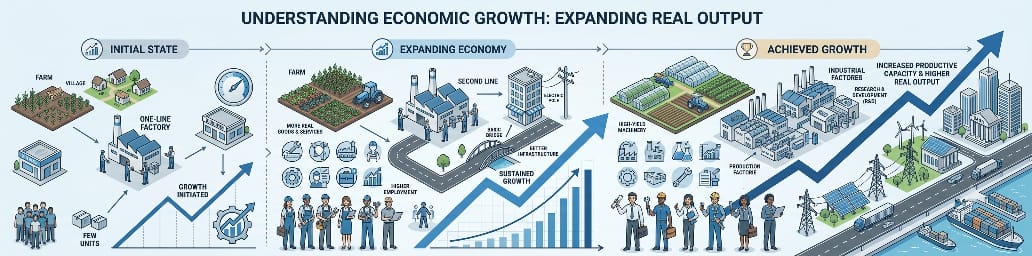
Economic Growth : Economic growth is the growth in the amount of goods and services that have been produced in the economy. Real GDP is usually used as an indicator for measuring economic growth as it eliminates the effects of change in prices and provides a better indication of growth in the quantity of goods produced. Gross domestic product (GDP) is important because it indicates the size and level of economic activity in an economy. However, GDP does not tell us everything about living standards in a country.
Economic Development : Economic development is the situation where a nation undergoes changes that improve the quality of life for ordinary people. Economic development examines issues such as increase in per capita income and GDP, increase in social indicators such as literacy and life expectancy, improved access to food, improved health status and jobs among others. Therefore, economic development encompasses economic growth, increased income levels and social welfare, among other things.
GDP and GNP
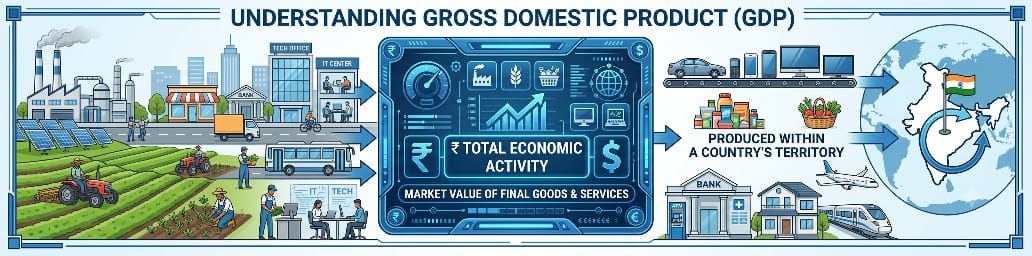
Gross domestic product (GDP) : is the market value of all final goods and services produced within a country in a particular period of time. (GDP) measures the level of production within a country's territory, and is a measure of economic activity and growth.
Gross National Income (GNI) : formerly known as Gross National Product (GNP), measures the income earned by a country's residents, including net primary income received from abroad.
NDP and NNP
Business organizations and governments acquire equipment and machinery to aid in the process of production. But these pieces of equipment get depreciated over time, which is the reason that there is a loss in their value. Depreciation is the term used for this reduction in value.
NDP = GDP – depreciation
NNP = GNP – depreciation
Real GDP and Nominal GDP
Nominal GDP: It is calculated based on the prices prevailing in the current year.
Real GDP: This is calculated based on constant prices, which eliminates the influence of changes in price level. Real GDP is a more appropriate measure for economic growth than nominal GDP.
GDP Deflator : The GDP deflator is a broad measure of the price level of domestically produced final goods and services. It can be calculated using the following formula:
GDP Deflator = (Nominal GDP ÷ Real GDP) × 100
The GDP deflator takes into consideration the price of all domestically produced final goods and services, not just the consumer basket goods. Unlike the CPI that measures price from the consumer's point of view, the GDP deflator looks at domestically produced final goods.
Login with