
Economics Made Simple: GVA, GDP Measurement, HDI and Economic Development
What Is GVA?
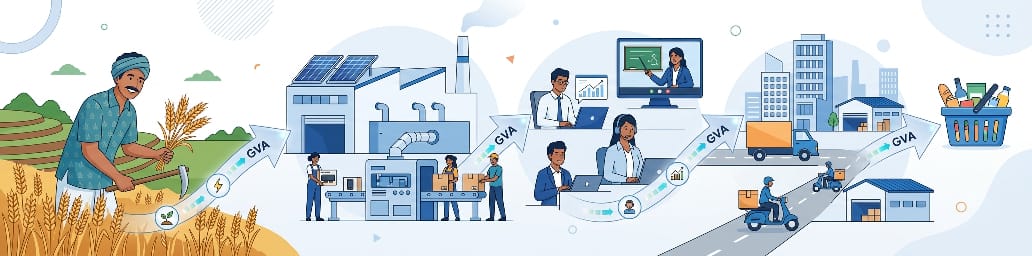
GVA refers to Gross Value Added. It is an economic measure of the total value that is added by producers minus the cost of intermediate consumption in the process of production. GVA = Value of Output - Intermediate Consumption For instance, a bakery earns ₹10 lakh from selling bread during one year. The costs of intermediate consumption are ₹6 lakh (flour, electricity, packaging, etc.). Hence, GVA equals ₹4 lakh. The importance of GVA lies in the fact that it allows us to calculate value added in various sectors of the economy.
What Is the Difference between GVA and GDP:
GVA is concerned with the contribution of producers and industries. GDP is calculated by adding up total value added along with taxes and subsidies on goods.
GDP = GVA + Taxes on Goods – Subsidies on Goods
For India, GVA is normally shown at basic prices while GDP is shown at market prices.GVA enables us to analyze the performance of various industries while GDP provides a broader view of the economy.
Three Approaches to Measuring GDP
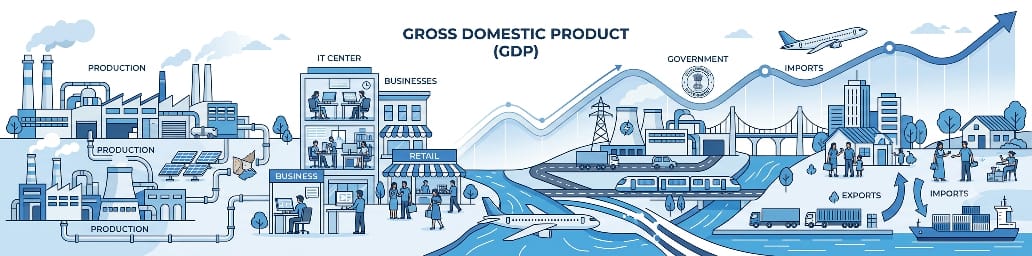
1. Production or Value-Added Approach : This method includes the value addition that occurs during each step of the production process. It prevents any sort of double counting because we don’t take into account the value of raw materials, intermediate goods, and final goods separately.
2. Income Approach
This method examines income earned from the process of production . Some of the elements include compensation to employees and income from operations. Income is earned when there is production of goods and services.
3. Expenditure Approach
This method is based on the expenditure of the goods and services.
GDP = C + I + G + (X – M)
Where,
C = Private consumption
I = Investment
G = Government expenditure
X = Exports
M = Imports
Exports are included because they are produced within the country, while the imports are excluded because they are produced in another economy.
All the three methods are based on the same economic activity but analyzed from different angles.
Factor Cost, Basic Price and Market Price
Factor Cost Price: This price is related to payments made for the factors of production, which are land, labor, capital, and entrepreneurship. Indirect taxes are excluded from this price concept, but it includes subsidies.
Basic Price: This price concept refers to the price received by producers before adding any product tax like GST and subtracting the product subsidy. To put it simply, it is almost the price that the producer really gets.
Market Price: This price concept refers to the price paid in the market. It includes product taxes and excludes product subsidies.
The Indian method of national accounting has changed with time. The modern Indian national accounting process includes: GVA is shown mostly in basic prices And GDP is shown in market prices.
Human Development: Looking Beyond GDP

The performance of a country cannot be judged through its productivity and income alone. Two countries can have similar income levels but may be very different with regard to education, health, and living conditions. And that’s when Human Development Index (HDI) comes into play. The HDI was developed under the guidance of economist Mahbub ul Haq at the UNDP and is greatly influenced by the theories of Amartya Sen on human capabilities and development. HDI looks into three main areas that are following.
1.Health :
Measured by life expectancy at birth.
Higher life expectancy generally indicates better health and living conditions.
2.Education :
Measured by Mean years of schooling for adults aged 25 and above.
Expected years of schooling for children of school-entering age.
3.Standard of Living :
GNI per capita measured on the basis of purchasing power parity (PPP). This shows an estimate of the resources that the people have to maintain their standard of living. HDI integrates these three factors in an index form through geometric mean. But HDI is not an all-encompassing measure of human well-being. There are certain other things which HDI does not measure such as inequality, environment, political participation, and security.
Relating to the Core Concepts in Economics
Economics starts from the concept of scarcity and making choices. Microeconomics is concerned about consumers, firms and markets. Macroeconomics deals with the aggregate economy. Factors of production that include land, labour, capital and entrepreneurship contribute towards the production of goods and services. Households consume. Firms produce. Government provides public services and regulation of activities. External sector links the economy of the country with the outside world. Economic sectors reveal the sector of production. Types of goods assist in determining the use and relation among goods.
GDP is the measurement of value of final goods and services produced in an economy. GVA reveals the value added by producers in different sectors. Real GDP helps in separating changes in production from changes in prices. three approaches to measure GDP provide production, income and expenditure approaches to GDP. HDI goes further than the measurement of production and income by taking into consideration health, education and quality of life.
In Short

Economics begins with a very basic assumption that there are limited resources but unlimited human needs and desires. With this concept, we can understand the principles of demand and supply, production, income, consumption, business, policy making, and international trade. GDP indicates the size and performance of an economy. On the other hand, GVA indicates the contribution of various sectors in the economy and real GDP enables us to differentiate between growth and inflation.
However, HDI takes this understanding to the next level by including health, education, and income. The basic difference is quite clear. Economic growth indicates the growth of the economy whereas economic development indicates the impact of the growth on the quality of life of its citizens.
Login with