
When you are preparing for competitive examinations such as IBPS, SBI, RRB, SSC or CAT, it won’t be surprising if you come across the topic called Ratio and Proportion. You will realize that Ratio and Proportion is not simply a stand-alone topic; it is the very foundation of Data Interpretation, Word Problems, Time-Speed-Distance and Profit & Loss.
Students who study the concepts related to Ratio and Proportion tend to cram formulae. However, it takes more than formulae in order to master the concepts related to Ratio & Proportion. This time, I will reveal the complete concept related to Ratio & Proportion.
The Foundation of Ratio
Ratio basically involves comparing two or more amounts of things. For instance, saying the ratio of apples to oranges is 3:5 implies that the number of apples is 3 while the number of oranges is 5.
I) The Golden Rule of Variables:
If A : B = 3 : 5, write A = 3x and B = 5x. Never assume their actual values are 3 and 5.
Example: Boys : Girls = 4 : 7, Total = 88
Boys = 4x
Girls = 7x
4x + 7x = 88
11x = 88 → x = 8
Boys = 4 × 8 = 32
Girls = 7 × 8 = 56
Note : Ratio parts × common multiplier = Actual values.
II) Proportion & Continued Proportion :
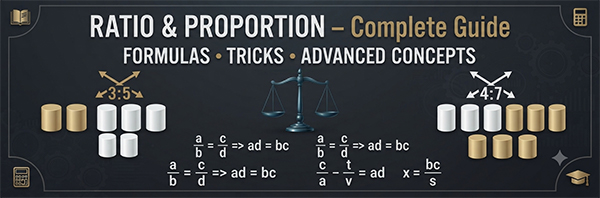
When two ratios are equal, they are considered to be in proportion. When \(\frac{A}{B}=\frac{C}{D}\), the product of the numerator of the first ratio and the denominator of the second ratio will be equal to the product of the denominator of the first ratio and the numerator of the second ratio.
This can be mathematically expressed by the formula \(A \times D=B \times C\).
e.g. If \(\frac{2}{3}=\frac{4}{6}\), then \(2 \times 6=3 \times 4\) or \(12=12\). Hence, the two ratios are equal.
III) Continued Proportion :
Three quantities are in continued proportion when \(a:b::b:c\). Here, \(b\) is the mean proportional.
For three terms: \(b^2=a\times c\)
For four terms: If \(p:q::r:s\), then \(p\times s=q\times r\).
e.g Find the Mean Proportional Between 4 and 25
Let the mean proportional be \(x\).
Since \(4:x::x:25\), we get:
\(\frac{4}{x}=\frac{x}{25}\)
Applying the cross product rule:
\(x^2=4\times25=100\)
Therefore, \(x=\sqrt{100}=10\).
Answer: 10
Types of Ratios : e.g of a and b
Duplicate Ratio: \(a^2:b^2\)
Sub-duplicate Ratio: \(\sqrt{a}:\sqrt{b}\)
Triplicate Ratio: \(a^3:b^3\)
Sub-triplicate Ratio: \(\sqrt[3]{a}:\sqrt[3]{b}\)
Compounded Ratio: \((a:b)\times(c:d)=ac:bd\)
The Golden Rules of Balancing (The Game Changer)
Here about 80% of exam questions come from. Balancing is used when a ratio changes due to addition, subtraction, or a constant value.
Golden Rule 1: One Variable is Constant :
If the ratio of Milk to Water is 3:2, and after adding 4 liters of water, the ratio becomes 5:4. Here, the Milk is constant. We balance the milk values.
Let, \[
\text{Milk} : \text{Water} = 3:2
\quad \xrightarrow{\times 5} \quad
15:10
\]
\[
\text{Milk} : \text{Water} = 5:4
\quad \xrightarrow{\times 3} \quad
15:12
\]
\(\therefore\)The change in water is 12 - 10 = 2 parts.
\[
2\textnormal{ parts} = 4\textnormal{ L}
\quad\Rightarrow\quad
1\textnormal{ part} = 2\textnormal{ L}
\]
\[
\textnormal{Total parts} = 15 + 10 = 25
\]
\[
\textnormal{Total mixture} = 25 \times 2 = 50\textnormal{ L}
\]
\[
\textnormal{Milk} = 15 \times 2 = 30\textnormal{ L},
\qquad
\textnormal{Water} = 10 \times 2 = 20\textnormal{ L}
\]
Golden Rule 2: Difference is Constant :
(Note : This is the hallmark of Age Problems. The difference between the ages of two people never changes.)
Example: 10 years ago, the ratio of ages of A and B was 5:3. 10 years from now, the ratio will be 3:2. Find their present ages.
Let ages 10 years ago be 5x and 3x. Difference = 2x.
Ages 10 years from now: 5x + 20 and 3x + 20. Difference remains 2x.
\[
\textnormal{New ratio: } \frac{5x + 20}{3x + 20} = \frac{3}{2}
\]
\[
\textnormal{Cross multiply: } 10x + 40 = 9x + 60 \Rightarrow x = 20
\]
\[
\textnormal{Present ages: } 5(20) + 10 = 110 \textnormal{ years}, \quad 3(20) + 10 = 70 \textnormal{ years}
\]
Business, Money, and Distribution
I) Profit, Capital, and Time
(The golden formula for partnership is: Profit = Capital × Time.)
If the profit ratio is P1 : P2, then \[
\frac{P_1}{P_2} = \frac{C_1 \times T_1}{C_2 \times T_2}
\]
Example: X, Y, and Z start a business. Their capitals are in the ratio 3:4:5. Their profit ratio is 6:5:4. Find the ratio of their investment periods.
\[
\textnormal{Time} = \frac{\textnormal{Profit}}{\textnormal{Capital}}
\]
\[
\textnormal{Time ratio} = \frac{6}{3} : \frac{5}{4} : \frac{4}{5}
\]
\[
\textnormal{LCM of } 3, 4, 5 = 60
\]
\[
\textnormal{Multiply each term by } 60:
\]
\[
\left(\frac{6}{3}\right) \times 60 : \left(\frac{5}{4}\right) \times 60 : \left(\frac{4}{5}\right) \times 60
\]
\[
= 6 \times 20 : 5 \times 15 : 4 \times 12
\]
\[
= 120 : 75 : 48
\]
\[
\textnormal{Simplifying by } 3:
\]
\[
= 40 : 25 : 16
\]
II) Coin Problems (Number vs. Value)
Note : (Total Value = Number of Coins × Denomination.)
Example: A bag contains 1, 2, and 5 ₹ coins in the ratio 3:4:5. The total value is Rs. 180. Find the number of 2 ₹ coins.
\(\therefore\)Let the number of coins be 3x, 4x, and 5x.
Total Value = (3x × 1) + (4x × 2) + (5x × 5)
Now, \[
3x + 8x + 25x = 180 \;\Rightarrow\; 36x = 180 \;\Rightarrow\; x = 5
\]
Number of 2 ₹ coins = 4x = 20.
III) Income, Expenditure, and Savings (IES)
( Income = Expenditure + Savings While working with percentage figures, change them into fractions.)
Example: A's income is 25% more than B's. A's expenditure is 20% less than B's. If A saves Rs. 5200 and B saves Rs. 2000, find their incomes.
we know ,\[
25\% = \frac{25}{100} = \frac{1}{4}
\] and \[
20\% = \frac{20}{100} = \frac{1}{5}
\]
Income ratio: A : B = 5 : 4.
Expenditure ratio: A : B = 4 : 5.
Let income be 5x, 4x. Let expenditure be 4y, 5y.
5x - 4y = 5200 ......(i) and
4x - 5y = 2000.. ....(ii)
Solve the two equations:
\[
\begin{aligned}
\textit{Multiply (i) by 5: } &\quad 25x - 20y = 26000 \\
\textit{Multiply (ii) by 4: } &\quad 16x - 20y = 8000 \\[6pt]
\textit{Subtract: } &\quad 9x = 18000 \\
&\quad x = 2000
\end{aligned}
\]
A's income = 5x = Rs. 10000
B's income = 4x = Rs. 8000
Advanced Miscellaneous Concepts
I) The ax = by = cz Problem :
When you see an equation like 4x = 5y = 6z, equate them to a constant k to get simplest ratio.
\( x = \frac{k}{4},\quad y = \frac{k}{5},\quad z = \frac{k}{6} \)
\( x : y : z = \frac{1}{4} : \frac{1}{5} : \frac{1}{6} \)
use LCM 60 \[
\frac{1}{4}:\frac{1}{5}:\frac{1}{6}
\;\xrightarrow{\times 60}\;
15:12:10
\]
II) Direct and Indirect Variation (Weight and Cost) :
If the cost of a diamond varies directly with the square of its weight Cost ∝ (Weight)². If a diamond breaks, the sum of the values of the pieces is always less than the original value.
Example: A diamond worth Rs. 81,000 breaks into pieces with weights in the ratio 1:2. What is the loss?
let, Original weight = 1 + 2 = 3 units.
\(\therefore\)\[
\text{Original Cost}
= k\cdot 3^2
= 9k
= 81000
\;\Longrightarrow\;
k=\frac{81000}{9}=9000
\]
\(\therefore\)Cost of pieces = k × (1² + 2²) = 9000 × 5 = 45000.
\(\therefore\)Loss = 81000 - 45000 = Rs. 36,000.
III) The Chocolate Sharing Trick
e.g.This is a classic conceptual question. A, B, and C share chocolates. A has 6, B has 4, C has 0. They share equally, and C pays Rs. 20 for his share. How do A and B split the money?
let, \( \text{Total chocolates} = 10,\qquad \text{Equal share} = \frac{10}{3}\ \text{each} \)
\( A:\ 6-\frac{10}{3}=\frac{8}{3},\qquad B:\ 4-\frac{10}{3}=\frac{2}{3} \)
\( \text{Ratio of chocolates given} = \frac{8}{3} : \frac{2}{3} = 4 : 1 \)
\[
\text{Money paid by }C = \text{Rs. }20
\quad\text{for}\quad
\frac{10}{3}\ \text{chocolates}
\]
\[
A\text{ gets} = \frac{4}{5}\times 20 = \text{Rs. }16
\]
\[
B\text{ gets} = \frac{1}{5}\times 20 = \text{Rs. }4
\]
Advanced Data Sufficiency & Quantity Comparison
How to approach them:
Note : Quantity I and II: Work out the solution fully and find both values. Compare and pick the right answer accordingly.
Data Sufficiency: See if Statement I alone, Statement II alone, or both combined are sufficient without making any assumptions.
Example: What is the savings of Rohit?
Statement I: Rohit's expenditure is Rs. 5000 per month.
Statement II: Income of Rohit is 20% more than the expenditure.
Explanation: Statement I provides expenditure and Statement II provides income in relation to expenditure. When expenditure is 5000 and income is 20% more than that, then income is 6000 and savings = 6000 - 5000 = 1000. Hence, both statements together are sufficient.
In Short
In this TestQuiz, you have covered the basic principles of Ratio and Proportion, the formulae, the balance method, and how to use them in ages, partnership, income and expenditure, and even in competitive exams. Establish a solid base on these principles, practice often, and increase your efficiency to score better in IBPS, SBI, RRB, SSC, and CAT exams.
Login with