

The Reserve Bank of India (RBI) is one of the agencies that is actively involved in safeguarding the interests of bank customers and ensuring fair and transparent customer services in the financial system. According to Section 35A of the Banking Regulation Act, 1949, the RBI is empowered to give directions to banking companies in the interest of the general public, in the interest of banking policy, to prevent the affairs of such banking companies from being conducted in such a manner as to be prejudicial to the interests of depositors, prejudicial to the interest of the banking company or ensure the proper management of such banks.
The Reserve Bank of India derives its regulatory and supervisory powers over Non-Banking Financial Companies (NBFCs) through the Reserve Bank of India Act, 1934, particularly sections 45 JA & 45 L. Further, under the Payment and Settlement Systems Act, 2007, the RBI derives its regulatory powers over the payment systems and may issue directions under provisions of the Act.
Consumer protection includes not only redressal of customer grievances but also improving customer service, transparency, rights of the customer, fair treatment and awareness about grievance redressal mechanisms among others.

RBI Initiatives to Improve Customer Service
Some initiatives taken by the Reserve Bank of India (RBI) in this regard are given below:
The banks are required to undertake reviews of the customer service issues and compliance of RBI’s instructions in this respect at the board level once in six months. In addition, the banks are required to constitute the Customer Service Committee of the Board and the Standing Committee for Customer Service.
It is suggested that banks form Customer Service Committees at branch level to record the feedback from the customers regarding customer service issues. In addition, the bank is required to have a nodal department or nodal officer for dealing with customer service and grievance related matters.
The banks are also required to keep the policy in place concerning the customer service, customer rights, deposit, cheque clearance, compensation and grievance redressal etc. which are approved by the Board of Directors of the bank.
Banking Ombudsman and Customer Grievance Redressal
Banking Ombudsman Scheme was instituted in 1995 by Reserve Bank of India (RBI) for addressing the grievances of the customers related to inadequate performance in the banking service sector. Banking Ombudsman Scheme, 2006, revised till July 1, 2017, allowed consumers to get grievances settled for any complaint that came under the ambit of the said scheme via Banking Ombudsman appointed by RBI.
The previous scheme was replaced by the Reserve Bank - Integrated Ombudsman Scheme, 2021, which amalgamated the Ombudsman Schemes of the RBI into one scheme. On July 1, 2026, the Reserve Bank - Integrated Ombudsman Scheme, 2026, superseded the earlier one for addressing consumer complaints against any regulated entity of RBI in a cost-free manner.
The Current Ombudsman Framework
The Banking Ombudsman Scheme, 2006, is now obsolete. The RBI has made an attempt to integrate all previous Ombudsman schemes for banks, NBFCs, and digital transactions through the Reserve Bank – Integrated Ombudsman Scheme, 2021.
As per the revised information released by the RBI dated July 1, 2026, the Reserve Bank – Integrated Ombudsman Scheme, 2026 (RB-IOS, 2026) replaced the 2021 scheme and is in force from the same date onwards. The RB-IOS, 2026, is a free, quick and non-confrontational grievance redressal process for eligible complaints of service deficiencies from regulated entities covered under the scheme.
Charter of Customer Rights
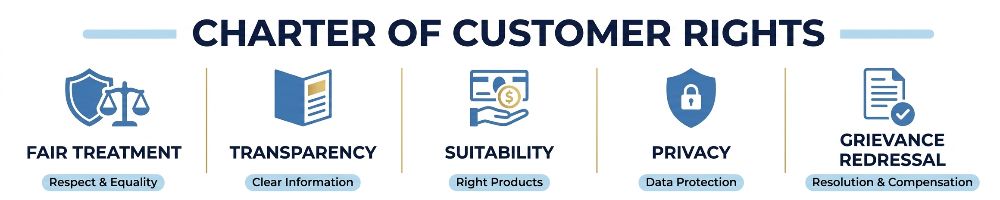
The RBI's Charter of Customer Rights spells out five fundamental rights meant to protect bank customers and ensure ethical banking practices.
Right to Be Treated With Fairness and Courteousness: Customers need to be treated with fairness and courtesy without any kind of undue discrimination.
Right to Transparency, Fair and Honest Conduct: The banks should be able to give information which is clear and understandable about the products, services, and the terms and conditions.
Right to Suitability: The products and services offered should suit the customers.
Right to Privacy: Personal and financial information of the customers should be secured from being misused.
Right to Grievance Redress and Compensation: The customers should be able to approach any means to redress the grievances and receive any kind of compensation.
Consumer Education and Protection Cells
In 2015-16, the RBI set up Consumer Education and Protection Cells at all regional offices of RBI. The aim of setting up these cells was that these would assist in addressing grievances not falling under the ambit of the Ombudsman Scheme existing then or grievances from entities under the regulation of RBI but falling outside this scheme. These cells were one among many such initiatives of the RBI towards better grievance redressal system and consumer education.
There have been changes in the names, composition and ambit of the grievance redressal systems in the past. This background of these cells should be viewed in light of the larger consumer protection system being run by the RBI.
RBI Initiatives for Financial Literacy
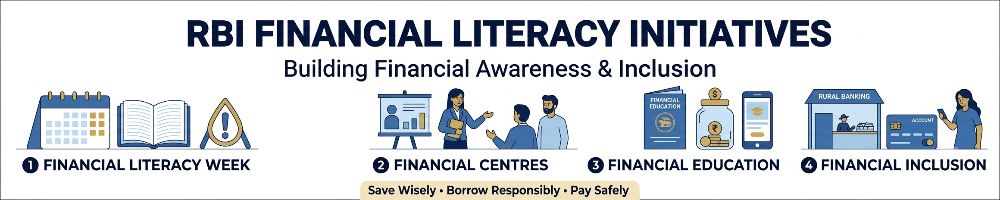
Financial literacy enables individuals to comprehend financial instruments, make sound financial decisions, use banking services in a responsible manner and be aware of the risks involved with borrowing, saving and digital payments. It supported by the Reserve Bank of India (RBI) by organizing programs like Financial Literacy Week, Financial Literacy Centers, financial literacy drives, and material in various languages.
Financial Literacy Centres
The RBI has directed that the banks should set up Financial Literacy Centers (FLCs) and carry out financial literacy activities through rural banking branches throughout the nation. Financial assistance for eligible activities can be availed from the Financial Inclusion Fund (FIF) maintained by the NABARD according to guidelines.
Financial Education Material
The Reserve Bank of India (RBI) has created educational resources on finances and made them accessible via its Financial Education website. These resources can be accessed in 13 languages, which helps banks and other stakeholders spread financial knowledge among individuals speaking different languages. These resources include information on financial products, financial literacy, digital transactions, and consumer protection.
Financial Literacy Week
Reserve Bank of India (RBI) celebrates FLW every year from 2016 onwards to enhance financial literacy all over India. Theme is chosen differently each year, which aims to take wise financial decisions and have responsible financial behavior. The theme is different every year and can be confirmed by checking the official announcement of RBI. The theme of FLW for 2026 is “KYC - Your First Step to Safe Banking.”
OECD/INFE Membership
RBI is a full member of the OECD/International Network on Financial Education (OECD/INFE), which is a part of the Organisation for Economic Co-operation and Development (OECD).The INFE aims at connecting policy makers and other stakeholders from across the world through exchange of information and best practices with regard to financial education.
National Centre for Financial Education (NCFE)
NCFE is a not-for-profit entity that has been registered under Section 8 of the Companies Act, 2013. It has been established by four regulatory bodies within the financial sector: RBI (Reserve Bank of India), SEBI (Securities and Exchange Board of India), IRDAI (Insurance Regulatory and Development Authority of India) and PFRDA (Pension Fund Regulatory and Development Authority).
There are two primary objectives of NCFE. The first one is to encourage the process of financial education within India for all classes of citizens in accordance with NSFE (National Strategy for Financial Education) linked with the FSDC (Financial Stability and Development Council). The second objective is to promote the process of financial awareness and empowerment through various educational programs like seminars, workshops, etc. The general objective of NCFE is to educate people about the financial instruments and financial decisions.
Financial Inclusion
It involves ensuring that people have access to meaningful financial services and products such as savings, credit, payments and insurance. Financial inclusion seeks to allow people and businesses, especially those in underserved communities, to access and utilize financial services to meet their requirements.
Major Reports Published by the RBI
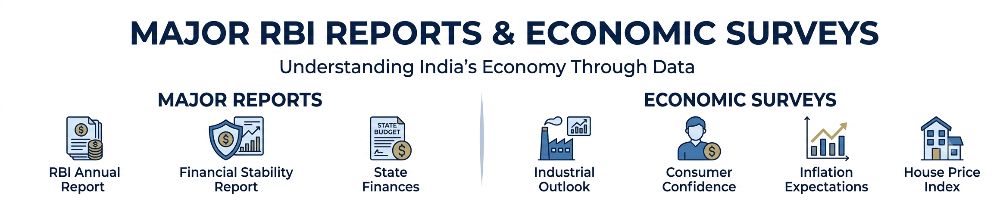
Annual Report
RBI Annual Report is a comprehensive record of the activities of the Bank for the reporting year. As per Section 53(2) of the Reserve Bank of India Act, 1934, the RBI should send its annual accounts together with the report made by the Central Board on the working of the Bank for the year to the Central Government within two months from the closing of its annual accounts.
The Annual Report is a useful source of information on the working of the Reserve Bank, monetary policies, financial sector situation and many other significant developments in the economy during the reporting year.
Report on Trend and Progress of Banking in India
It is an annual statutory report which is prepared by the Reserve Bank of India (RBI). This report is presented to the Central Government as per the provisions of Section 36(2) of the Banking Regulation Act, 1949.
This report is a critical review of the functioning of commercial banks, cooperative banks, and other non-banking financial institutions. Through this report, readers can understand the trends prevailing in the banking sector.
Financial Stability Report (FSR)
FSR is an annual publication by the Sub-Committee of Financial Stability and Development Council (FSDC). It contains the joint evaluation of the Sub-Committee on the financial stability and robustness of the Indian financial system to various risks that may arise both within the country and internationally. Macro-financial risks, financial institution soundness and their robustness to shocks and developments in the financial sector regulations are some of the important components of the FSR.
Handbook of Statistics on Indian States
It is the annual publication by the Reserve Bank of India (RBI) which provides statistics on a large number of socio-economic indicators on a state-wise basis. These include statistics on socio-demographic factors, state domestic product, agriculture, industry, infrastructure, financial sector, and other aspects. The handbook serves as a good source to understand economic and social differences among Indian states.
State Finances: A Study of Budgets
The RBI prepares the publication State Finances: A Study of Budgets that provides a study on the fiscal position of state governments by analyzing their budgets. The report focuses on various aspects such as the receipts, expenditures, deficits, and debts of state governments. This allows the reader to be aware of the fiscal position of state governments.
Annual Census on Foreign Liabilities and Assets of Indian Companies
To gather data about the foreign liabilities and assets of Indian firms that have made direct investments across borders, the RBI undertakes the Annual Census of Foreign Liabilities and Assets (FLA).
It enables the participation of India in the International Monetary Fund’s Coordinated Direct Investment Survey (CDIS) and Coordinated Portfolio Investment Survey (CPIS). The data gathered is also utilized in generating the BoP and IIP statistics of India.
RBI Surveys on Economic Conditions

Survey of Professional Forecasters
The RBI began the Survey of Professional Forecasters (SPF) in September 2007. It includes the forecasts of the economic performance in India by professional economists for about 20 macroeconomic variables per year and quarter. These include growth rate of GDP, inflation, banking variables, and external sector performance. The results can be used to understand the expectations of the experts about the Indian economy and its future course.
Industrial Outlook Survey
RBI has been carrying out the Industrial Outlook Survey (IOS) since 1998. This survey is conducted quarterly to analyze the business sentiments of the manufacturing industry, based on their perceptions of prevailing industrial conditions and their expectations for the next quarter. The IOS takes into account aspects such as demand, production, employment, finance, and price conditions.
Order Books, Inventories and Capacity Utilisation Survey
The Reserve Bank of India has been carrying out OBICUS survey quarterly since 2008. This survey was started in order to generate information on order books, inventories and capacity utilization in the manufacturing sector of India.
It generates information on new and outstanding orders, finished goods inventory, work-in-progress inventory and raw material inventory, and production in relation to installed capacity. These results assist in evaluating the state of demand, measuring capacity utilization, and gauging changes in manufacturing activity.
Inflation Expectations Survey of Households (IESH)
IESH has been carried out by the Reserve Bank of India (RBI) starting from September 2005. IESH measures households' perceptions regarding current level of inflation and future movements in prices. Inflation expectations affect the behavior of households in terms of consumption, savings and purchases. These expectations also play an important role in shaping monetary policy decisions since expectations can impact price setting and economic behavior. IESH therefore offers valuable insights to RBI for formulating its monetary policy under inflation targeting framework.
Consumer Confidence Survey
RBI has been undertaking the Consumer Confidence Survey (CCS) since 2010. This survey measures consumer perceptions regarding the economic environment, prices, employment, household income, spending, and their own financial environment. The survey also takes into account expectations for the following year.
Consumer confidence is an indication of household perceptions about present economic environment and future outlook. Alterations in consumer confidence levels can impact spending behavior and consequently the economy. Therefore, the information gained from this survey is helpful in the RBI analysis of economic environment and monetary policy. Sampling methodology used in this survey, number of households to be surveyed, cities to be included, and frequency of the survey can vary over time. This needs to be ascertained from the latest RBI survey.
House Price Index
The Reserve Bank of India prepares a quarterly House Price Index (HPI), which measures changes in residential property prices. This index is useful for evaluating trends in the housing market and their connections with the credit environment and households’ financial stability.
The attached notes contain information about an index whose base year is 2010-11 = 100, with respect to all India and ten large cities – Mumbai, Delhi, Chennai, Kolkata, Bangalore, Lucknow, Ahmedabad, Jaipur, Kanpur and Kochi. Data used in the preparation of this index come from property transactions recorded by the concerned state government’s registration departments, and the index construction follows the Laspeyres price index formula.
In Short
The RBI activities are not only focused on monetary policies but also cover customer protection, financial education, and economic statistics collection. Customer service programs and grievances resolution measures deal with problems associated with financial services, and financial literacy programs increase knowledge about banking and finance among the population. Reports and surveys of the RBI give information about the functioning of the banking system, economic forecasts, business and consumer sentiments, state budgets, and housing market.
Login with