
The Complete Guide to Percentages: From Fractions to Advanced Applications
Percentages are everywhere—discounts, exam scores, interest rates, election results, population growth, and even cricket run rates. But many students memorize formulas without understanding the logic. In this blog, we’ll build a strong foundation and then move to advanced applications, using fresh examples so the concepts stick.
1. What Exactly Is a Percentage?
The word “percent” means “per hundred.” So 25% simply means 25 out of 100, or  .
.
Why do we use percentages?
To compare quantities with different bases. For example, comparing  and
and  is easier if we convert both to percentages: 60% and 70%. Suddenly the comparison is obvious.
Quick example:
If a shirt costs ?800 and a shoe costs ?1,200, saying the shirt is 66.66% of the shoe’s price gives an instant sense of proportion.
2. Fraction ↔ Percentage Relationship
Memorizing common conversions saves precious exam time.
|
Fraction |
Percentage |
|
1/2 |
50% |
|
1/3 |
33.33% |
|
1/4 |
25% |
|
1/5 |
20% |
|
1/6 |
16.66% |
|
1/7 |
14.28% |
|
1/8 |
12.5% |
|
1/9 |
11.11% |
|
1/10 |
10% |
|
1/11 |
9.09% |
|
1/12 |
8.33% |
Three powerful tricks:
- Complement method: If a fraction is close to 1, subtract from 1.
Example: .
. - Splitting method: Break into known parts.
Example: .
. - Scaling method: Multiply or divide both fraction and percentage by powers of 10.
Example: Since , then
  and
and  .
.
Type 1: Find x% of y
Formula: 
Example: 35% of 240 = 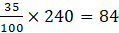 .
.
Type 2: a is what % of b?
Formula: 
Example: 54 is what % of 90? 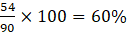 .
.
3. Percentage Change and Comparison
Increase by r%: Multiply by  .
.
Decrease by r%: Multiply by  .
.
Example: A phone priced at ?800 is increased by 25% → ?1,000. Then decreased by 20% → ?800. It returns to the original price!
Comparison formulas:
- A is what % more than B?

- A is what % less than B?

Example: 90 is what % more than 75? 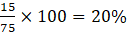 .
.
75 is what % less than 90? 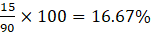 .
.
Remember: The base is always the number after “than” or “of.”
4. Successive Percentage Change
When two changes happen one after another, don’t just add or subtract. Use:
Example: +20% then –10% net increase.
Ratio method: Convert each change to an Old : New ratio, then multiply corresponding terms.
Example: +25% then –20%
+25% → Old : New = 4 : 5
–20% → Old : New = 5 : 4
Old total = 4 × 5 = 20, New total = 5 × 4 = 20 → no change.
For more than two changes: Multiply the factors.
Example: +10%, –20%, +25% →  → 10% net increase.
5. Real-World Applications
A. Salary, Expenditure, and Savings
When a person spends a percentage of salary, then a percentage of the remaining, the base changes each time. Always work step by step.
Fresh example:
Salary = ?8,000. Spends 20% on rent, 25% of the remaining on food, and 10% of the remaining on travel.
- Rent = 20% of 8000 = ?1,600 → remaining ?6,400
- Food = 25% of 6400 = ?1,600 → remaining ?4,800
- Travel = 10% of 4800 = ?480 → savings = ?4,320.
Difference method:
If the difference between house rent and shopping is ?2,000, and salary is 4x, form an equation and solve for x.
B. Election Problems
Elections involve stages: Total voters → Cast votes → Valid votes → Candidate votes.
Formula:

Fresh example:
Total voters = 20,000. 80% cast votes, 5% of cast votes are invalid.
- Cast = 16,000
- Valid = 16,000 × 0.95 = 15,200
- Winner gets 55% of valid = 8,360; loser gets 45% = 6,840. Margin = 1,520.
C. Set Theory and Venn Diagrams
Two subjects:

Fresh example:
60 students passed Math, 50 passed Science, 20 passed both. Total students = 120.
Passed at least one = 60 + 50 – 20 = 90.
Failed both = 120 – 90 = 30.
Three subjects:

Fresh example:
Fail in A = 40%, B = 50%, C = 60%. A&B = 20%, B&C = 25%, A&C = 30%. All three = 10%.
Total fail = 40 + 50 + 60 – 20 – 25 – 30 + 10 = 85%.
Passed all three = 100 – 85 = 15%.
D. Commission, Income Tax, and Population
Commission:
A salesman gets 5% up to ?20,000 and 3% above that.
Sales = ?40,000 → Commission = 5% of 20,000 + 3% of 20,000 = 1,000 + 600 = ?1,600.
Income Tax:
Gross – Tax = Net.
If tax rate increases by 20% and net income decreases by 2%, find original rate.
Let original tax = T, net = N.
New tax = 1.2T, new net = 0.98N.
Since gross is constant: T + N = 1.2T + 0.98N → 0.02N = 0.2T → N = 10T.
Gross = 11T. Original tax rate = T / 11T × 100 = 9.09%.
Population (weighted change):
Total = 10,000. Male +15%, Female +5%, total +8%.
If everyone increased by 5%, total would be 10,500. Actual = 10,800. Extra 300 comes from extra 10% males.
10% of males = 300 → Males = 3,000.
E. Miscellaneous Problems
Passing marks:
A student got 25% and failed by 20 marks. Another got 40% and passed by 10 marks.
Difference = 15% = 30 marks → Total = 200.
Pass mark = 25% of 200 + 20 = 70.
Distribution:
Assets divided among wife, sons, daughters, grandchildren with given ratios.
Set each grandchild = G, then son = 6G, daughter = 9G.
Use the given value of one share to find all.
Cricket runs:
Virat hits x fours, (x–1) sixes, and running runs = 3x. Total = 150.
Solve for x, then find singles and doubles using the given conditions.
6. Advanced Variable-Based Problems
Sometimes percentages are given as  ,
,  , or
, or  . Treat them as algebraic expressions and form equations.
Fresh example 1:
A number increased by  becomes 330 from 300.
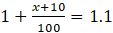 →
→  →
→  →
→  .
.
Fresh example 2:
Population 5,000. Increased by  then
then  , final 6,006.
Solve the quadratic to find x, then calculate the required percentage.
Set theory with variables:
In a class, x% passed both English and Hindi, 1.5x% failed both, 60% failed Hindi. Difference between passed English and Hindi is 30. Total = 400.
Use Venn diagram regions and form equations to solve for x.
7. Key Takeaways
- Percentage = per 100. Convert to fractions for faster calculation.
- Memorize standard fraction–percentage pairs.
- Successive changes: Use
 or the ratio method.
 - Base is everything in comparison problems.
- Set theory: Draw Venn diagrams. Use inclusion–exclusion.
- Elections: Track total → cast → valid → candidate.
- Salary/expenditure: Work step by step; the base changes.
- Variable percentages: Treat as algebra, form equations.
- Always verify by substituting back.
Percentages are not just a chapter—they are a life skill. Master the basics, practice applications, and you’ll handle any problem with confidence.
Login with