Mixture & Alligation: The Complete Human-Friendly Guide
If you’ve ever solved a “milk and water” problem, you’ve already met mixtures. But mixture problems are not just about milk and water—they show up in profit/loss, averages, chemical fertilizers, and even multi-vessel transfers. The good news? Almost every mixture problem is built on a few simple ideas. Once you understand them, you can solve even the advanced ones without memorizing hundreds of questions.
This blog is a complete concept revision based on a full set of mixture & alligation notes—from basics to advanced. I’ve changed the example numbers so you can see the concepts fresh, but the logic remains exactly the same.
1. The Absolute Basics: What Is a Mixture?
A mixture is a homogeneous combination of two or more components. “Homogeneous” means the ratio is the same throughout. If you take a spoonful from anywhere in the mixture, the ratio of components is identical.
Key Rule
If you remove a part of a homogeneous mixture, the removed part has the same ratio as the original. And if you only remove (without adding anything), the remaining mixture keeps the same ratio.
Example:
A 120 L mixture has spirit and water in the ratio 7:5.
Total parts = 12. One part = 10 L.
Spirit = 70 L, Water = 50 L.
If you remove 30 L, the remaining 90 L still has spirit:water = 7:5.
Removed part also has 7:5.
2. Adding One Component
When you add only one component (say water), the other component (say milk) stays the same. That unchanged component becomes your anchor.
Example: Add Water
A 90 L mixture has milk and water in the ratio 5:1. How much water must be added to make the ratio 10:3?
Initial: Milk = 75 L, Water = 15 L.
Milk stays 75 L.
Let added water = x.


Example: Add Milk
A 60 L mixture has milk:water = 3:2. How much milk must be added to make it 7:3?
Initial: Milk = 36 L, Water = 24 L.
Water stays 24 L.
Let added milk = x.


3. Vaporization and Evaporation
When water evaporates, only water reduces. The solute (sugar, salt, milk solids) remains unchanged.
Example:
A mixture has sugar and water in the ratio 7:11. When 36 L of water is vaporized, the quantities become equal. Find the initial quantity.
Sugar = 7 parts, Water = 11 parts.
After vaporization, water becomes 7 parts.
Water reduced by 4 parts = 36 L → 1 part = 9 L.
Total initial = 18 parts = 162 L.
4. Alligation: The Magic Cross
Alligation is a shortcut to find the ratio in which two ingredients must be mixed to get a desired mean value. It’s just weighted average in disguise.
Formula
Let cheaper value = x, dearer value = y, mean = z.
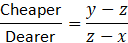
Diagram
text
Cheaper (x) Dearer (y)
\ /
\ /
Mean (z)
/ \
(y - z) (z - x)
Example 1: Milk Percentages
Mixture P has 30% milk, Mixture Q has 70% milk. What ratio should they be mixed to get 50% milk?

Example 2: Prices
Two types of sugar cost Rs.40/kg and Rs.60/kg. What ratio to mix to get a mixture worth Rs.48/kg?

Example 3: Profit and Adulteration
A milkman sells a milk-water mixture at Rs.6 per litre and earns a 50% profit. If pure milk costs Rs.8 per litre, find the milk:water ratio.
CP of mixture = SP / (1 + Profit%) = 6 / 1.5 = Rs.4.
Water costs Rs.0.
Alligation: Milk (8), Water (0), Mean (4).

Example 4: Averages
In a class, boys average 60 kg, girls average 40 kg, and the whole class averages 48 kg. If there are 50 students, how many boys?

Total parts = 5. 1 part = 10.
Boys = 2 × 10 = 20.
5. Multiple Replacement
This is where things get interesting. If you repeatedly remove a fixed fraction of a mixture and replace it with another component (usually water), the amount of the non-added component decreases exponentially.
Formula

where  = number of operations.
Example 1: Basic Replacement
A vessel has 100 L pure milk. 20 L is removed and replaced with water. This is done twice. How much milk is left?
Fraction removed = 20/100 = 1/5.

Example 2: Finding the Removed Quantity
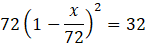
72 L pure milk.  L is removed and replaced with water twice. Finally, water is 40 L. Find .
Final milk = 72 – 40 = 32 L.


Example 3: Wine Replacement
80 L pure wine. 25% is removed and replaced with water. Repeated 3 times. How much wine is left?
25% = 1/4.

Key tip: Always track the component that is never added.
6. Complex Multi-Vessel Problems
These problems involve several vessels, each with its own ratio, and sometimes transfer between vessels.
Example: Three Vessels
Vessels A, B, C have quantities in ratio 1:1:2.
A has milk:water = 2:1.
B has water:milk = 1:2 (so milk:water = 2:1).
C has milk:water = 3:1.
When all are mixed, milk exceeds water by 40 L. Find total quantity in A and B.
Let A = x, B = x, C = 2x.
A: M = 2x/3, W = x/3
B: M = 2x/3, W = x/3
C: M = 1.5x, W = 0.5x
Total M = 17x/6, Total W = 7x/6
Difference = 10x/6 = 5x/3 = 40 ⇒ x = 24.
A + B = 2x = 48 L.
Example: Transfer Between Jars
Jar A has 60 L milk:water = 5:1.
Jar B has milk:water = 3:2.
12 L from A is poured into B. Now the difference between milk and water in B is 18 L. Find initial milk in B.
12 L from A: Milk = 10 L, Water = 2 L.
Let B initially have milk = 3k, water = 2k.
After transfer: Milk = 3k + 10, Water = 2k + 2.
Difference = (3k+10) – (2k+2) = k + 8 = 18 ⇒ k = 10.
Initial milk in B = 3k = 30 L.
7. Miscellaneous Advanced Concepts
Replacement with Another Mixture
A 200 L mixture has acid:spirit = 3:5. 50 L is removed and replaced with a mixture having acid:spirit = 1:1. Find the final ratio.
Initial: Acid = 75, Spirit = 125.
Remove 50 L (3:5): Acid removed = 18.75, Spirit removed = 31.25.
Remaining: Acid = 56.25, Spirit = 93.75.
Add 50 L (1:1): Acid = 25, Spirit = 25.
Final: Acid = 81.25, Spirit = 118.75 = 13:19.
Chemical / Fertilizer Mixtures
AS fertilizer has N=20%, P=60%, K=20%.
AP fertilizer has only N and P.
A mixture of AS and AP has N=30%, P=65%, K=5%.
Find N:P in AP.
K comes only from AS.
0.20 × AS = 0.05 × Total ⇒ AS = Total/4, AP = 3/4 Total.
Let Total = 100. AS = 25, AP = 75.
N from AS = 5. Total N = 30 ⇒ N from AP = 25.
P from AS = 15. Total P = 65 ⇒ P from AP = 50.
N:P in AP = 25:50 = 1:2.
Multi-Level Mixing
Item K is made by mixing Chemical A and B in ratio 7:5.
Chemical A = X:Y = 2:5.
Chemical B = Y:Z = 3:2.
756 units of K are mixed with water so that Y concentration becomes 45%. How much water?
Y in A = 5/7. Y in B = 3/5.
K = A:B = 7:5.
Y in K = (7×5/7 + 5×3/5) / 12 = (5 + 3)/12 = 8/12 = 2/3.
Y in 756 units = 504.
Final concentration = 45% = 0.45.

Weighted Averages with Sections
Four sections A1, A2, A3, A4 have average marks 44%, 52%, 70%, 79%.
Overall average = 65%.
(A1+A2) average = 47%, (A2+A3) average = 65%.
Find A1:A4.
From (A1,A2)=47%:

From (A2,A3)=65%:

Combine: A1:A2:A3 = 25:15:39.
Let A4 = x. Overall average 65% gives:

Solving gives A1:A4 = 2:3.
8. Quick Recap & Formula Sheet
|
Concept |
Formula / Rule |
|
Homogeneous removal |
Ratio unchanged |
|
Add one component |
Other component unchanged |
|
Vaporization |
Solute unchanged |
|
Alligation |
Cheaper:Dearer = (Dearer–Mean):(Mean–Cheaper) |
|
Multiple replacement |
Final = Initial × (1 – Removed/Total)^n |
|
Profit/Loss |
CP = SP / (1 ± Profit/Loss%) |
|
Weighted average |
Avg = (n1A1 + n2A2 + …) / (n1+n2+…) |
|
Multi-vessel |
Write equations for each component, solve |
Final Words
Mixture and alligation problems look scary because they combine ratios, percentages, and equations. But they all boil down to a few ideas:
- Identify what doesn’t change (milk when adding water, solute when evaporating, etc.).
- Use alligation when two things are mixed to get a mean.
- Use the replacement formula when the same operation repeats.
- For complex problems, write equations for each component.
Practice with different numbers, and soon you’ll see the same patterns everywhere. Happy solving!
Login with