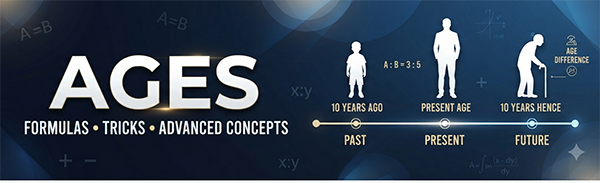
Mastering Ages Problems: From Basics to Advanced (A Complete Blog Guide)
Hey everyone! If you're preparing for competitive exams like IBPS, SBI, RRB, or SSC, you've definitely encountered the Ages chapter. It looks simple at first—just some ratios and years—but it can get tricky when families, averages, and constraints come into play.
I've gone through a comprehensive set of notes on Ages (Basic, Miscellaneous, and Advanced) and distilled everything into this single blog post. I'll explain every concept in a human-friendly way, and wherever there was an example, I'll change the numbers and scenario slightly so you understand the concept without memorizing the exact question.
Let's dive in!
1. The Foundation: Present Age is Your Base
Every ages problem revolves around the present age. If you can express everything in terms of the present, you're halfway there.
- n years ago → subtract n from present age.
- n years hence → add n to present age.
- If data is not given, assume the present age as the reference.
Example:
If A is 30 years old now, then 5 years ago A was 25, and 7 years hence A will be 37. Simple, right?
2. The Golden Rule: Difference of Ages is Constant
No matter how many years pass, the difference between the ages of two persons never changes.
If A is 8 years older than B today, A will still be 8 years older than B after 20 years. This is a powerful tool to eliminate variables.
Example:
A is 6 years older than B. The sum of their ages is 40. Find A's age.
Let A = x, B = x − 6.
x + (x − 6) = 40 → 2x = 46 → x = 23.
So A is 23, B is 17. (Difference = 6, always.)
3. Sum of Ages Changes with Time
- For two persons, the sum of their ages increases by 2n in n years.
- For m persons, the sum increases by m × n in n years.
- When a new member joins (birth, marriage) or leaves (death, marriage), update the total sum and the number of members.
Example:
A family of 4 has an average age of 30. After a marriage, a new member joins and the average becomes 31. Find the age of the new member.
Initial sum = 4 × 30 = 120.
New sum = 5 × 31 = 155.
New member's age = 155 − 120 = 35 years.
4. Ratio Method & Cross Multiplication
Most ages problems give ratios. Let the ages be ax and bx. Then use cross multiplication to solve.
Example (changed numbers):
5 years ago, A : B = 3 : 2. 9 years hence, A : B = 5 : 4. Find B's present age.
Let 5 years ago ages be 3x and 2x.
Present: 3x+5, 2x+5.
9 years hence: 3x+14, 2x+14.
Given (3x+14)/(2x+14) = 5/4.
Cross multiply: 4(3x+14) = 5(2x+14) → 12x+56 = 10x+70 → 2x=14 → x=7.
B's present age = 2x+5 = 19 years.
5. Average to Sum Conversion
Whenever you see an average, immediately convert it to a sum:
Sum = Average × Number of persons
This turns average problems into simple equation problems.
Example:
The average age of A, B, and C is 28. So, A+B+C = 84. Now you can use other conditions to solve.
6. Timeline Alignment for Birth & Marriage
When births, marriages, or deaths are involved, draw a timeline. Place the events and express all ages relative to a common point.
- If A was born x years after B, then Age(B) − Age(A) = x.
- At the time of birth, age = 0.
Example (changed numbers):
A father was 32 when his daughter was born. The mother was 28 when the son was born. The daughter is 4 years older than the son. What is the age difference between the parents?
Let daughter born at t=0. Son born at t=4.
Father's age at son's birth = 32 + 4 = 36.
Mother's age at son's birth = 28.
Difference = 36 − 28 = 8 years.
7. Percentage to Fraction Conversions
Many problems use percentages. Convert them to fractions for easier calculation.
|
Percentage |
Fraction |
|
12.5% |
1/8 |
|
20% |
1/5 |
|
25% |
1/4 |
|
33.33% |
1/3 |
|
37.5% |
3/8 |
|
40% |
2/5 |
|
66.66% |
2/3 |
|
75% |
3/4 |
|
90% |
9/10 |
Also remember:
- "A is 25% more than B" → A = 1.25B = 5/4 B.
- "A is 20% less than B" → A = 0.8B = 4/5 B.
8. Basic Problem Types (with Changed Examples)
Type 1: Two-Time Ratio
Example: 6 years ago, A : B = 4 : 3. 6 years hence, A : B = 6 : 5. Find A's present age.
Let 6 years ago: A=4x, B=3x.
Present: 4x+6, 3x+6.
6 years hence: 4x+12, 3x+12.
(4x+12)/(3x+12) = 6/5 → 20x+60 = 18x+72 → 2x=12 → x=6.
A's present age = 4x+6 = 30 years.
Type 2: Fractional Relation
Example: 4 years ago, a daughter was 1/3 of her mother's age. 4 years hence, she will be 1/2 of her mother's age. Find the age difference.
Let 4 years ago daughter = x, mother = 3x.
Present: x+4, 3x+4.
4 years hence: x+8, 3x+8.
(x+8)/(3x+8) = 1/2 → 2x+16 = 3x+8 → x=8.
Present daughter = 12, mother = 28. Difference = 16 years.
Type 3: Age Difference Constant
Example: A is 10 years older than B. The sum of their ages is 50. Find A.
A − B = 10, A + B = 50.
Add: 2A = 60 → A = 30.
9. Miscellaneous Concepts
Family Average & Membership Changes
Track total sum and count. When a child is born, age = 0 at birth; after n years, child's age = n.
Example:
A family of 5 has an average age of 27. After a marriage, a new female member joins and the average increases by 6 months (0.5 years). Find the age of the new member.
Initial sum = 5 × 27 = 135.
New average = 27.5, new count = 6, new sum = 6 × 27.5 = 165.
New member's age = 165 − 135 = 30 years.
Quadratic Age Problems
Sometimes the statement translates to a quadratic equation. Solve it and reject negative or unrealistic roots.
Example (changed numbers):
A boy says: "Twice the square of my age minus 20 times my age equals thrice your age." His friend is 12 years old. Find the boy's age.
Let boy's age = x.
2x² − 20x = 3 × 12 = 36 → 2x² − 20x − 36 = 0 → x² − 10x − 18 = 0.
Solving gives x ≈ 11.6 (not integer) or negative. So maybe adjust numbers to get integer.
Let's use: 2x² − 25x = 42 (friend 14). → 2x² − 25x − 42 = 0 → (2x+3)(x−14)=0 → x=14.
So boy's age = 14.
Integer / Prime / Perfect Square Constraints
Advanced problems often impose conditions like:
- Age is a prime number > 40.
- q lies between the second and third smallest natural perfect squares (i.e., between 4 and 9, so q = 5, 6, 7, or 8).
- All ages are integers.
Use these to eliminate options quickly.
10. Advanced Problems: Multiple Variables & Constraints
When 4–8 persons are involved, assign one variable per unknown or use a common multiplier x. Form a system of equations.
Example (concept):
A is p years elder to B. B is q years younger to C. A is 2 years elder to C. D is 5 years elder to B. q lies between 4 and 9. Ratio of A after q years to B after (p−2) years is 7:6. B's present age is a prime > 40. Find D − (p+q) years ago.
Approach:
- Write A = B + p, C = B + q, A = C + 2 → p − q = 2.
- Use ratio equation: (A+q)/(B+p−2) = 7/6.
- Substitute A = B+p and p = q+2.
- Solve for B, then apply prime > 40 and q between 4 and 9.
- Finally compute D = B+5, then D − (p+q).
This systematic approach works for any complex problem.
11. Option Verification Technique
When multiple values seem possible, plug the options into the statement and check which one makes it true.
Example:
Average of A, B, C is 58. Average of A and B is 67. If B is __% more than C, then A is __ years.
Options: I. 75, 64 II. 65, 68 III. 60, 70
Check each:
From averages, A+B = 134, A+B+C = 174 → C = 40.
Then B = 174 − A − 40 = 134 − A.
For each option, calculate B and check if B is that % more than C (40), and A matches.
You'll find all three work. So answer: All I, II, III.
12. Common Mistakes to Avoid
- Forgetting to add/subtract years correctly (especially with “ago” and “hence”).
- Not converting average to sum.
- Ignoring integer constraints.
- Assuming age difference changes over time.
- Keeping negative roots in quadratic problems.
- Not drawing a timeline for birth/marriage problems.
13. Final Tips for Exams
- Draw a timeline whenever births, marriages, or deaths are involved.
- Convert everything to present as the base.
- Use ratio and cross multiplication for two-time ratio problems.
- Always convert averages to sums immediately.
- Use age difference constant to eliminate variables.
- Apply integer/prime/perfect square constraints to narrow down options.
- Check options when multiple values satisfy.
- Practice mixed problems combining ratio, average, and percentage.
Conclusion
Ages is not just about adding and subtracting years. It's a beautiful application of ratio, percentage, average, and algebra. Once you master the basics—present age, difference constant, and sum changes—you can tackle any miscellaneous or advanced problem.
Remember, the key is to translate words into equations and use constraints to simplify. With regular practice, you'll be able to solve even the toughest Ages questions in minutes.
Happy learning, and all the best for your exams!
Login with