
Partnership Problems: The Only Guide You Need (From Basics to Mains)
Hey folks! If you're preparing for banking, SSC, or any competitive exam, partnership is one of those topics that looks scary but is actually just one simple idea wrapped in different costumes. Once you see through the disguise, every question becomes a variation of the same theme.
In this blog, I'm going to walk you through every partnership concept — from the basic Capital × Time rule to advanced mains-level twists. I've changed all the example numbers so you can learn the concept without memorising a specific question. Let's dive in.
1. The Golden Rule: Profit ∝ Capital × Time
At its heart, partnership is about one thing:

Where  is the capital invested and
  is the time period (in months or years). The total investment for each partner is simply
  .
.
Example:
A invests Rs. 10,000 for 6 months.
B invests Rs. 15,000 for 8 months.
Total investment of A = 
Total investment of B = 
Profit ratio = 
If the total profit is Rs. 9,000, then A gets  and B gets
  .
.
That's it. Everything else is just adding layers to this basic idea.
2. When Capital Changes: Withdrawal or Addition
Sometimes a partner withdraws or adds money during the year. Then you can't just multiply the initial capital by 12. You have to break the time into segments.
Rule: Calculate investment for each segment separately, then add them up.
Example:
A invests Rs. 20,000 for 5 months. After that, he withdraws  of his capital. Find his total investment at the end of the year.
- First 5 months:

- Withdrawal:

- Remaining capital:

- Remaining 7 months:

- Total investment =

If B invested Rs. 25,000 for the whole year, B's total =  .
.
Profit ratio =  .
.
3. Active (Working) Partner vs Sleeping Partner
An active partner manages the business and usually gets a salary, commission, or a percentage of profit before the remaining profit is divided. A sleeping partner only invests money and gets a share based purely on capital.
Rule: Deduct the working partner's extra share first. Then divide the remaining profit in the capital ratio.
Example:
A is an active partner and invests Rs. 25,000. B is a sleeping partner and invests Rs. 20,000. A receives 20% of the profit for managing the business. Total profit = Rs. 18,000.
- A's management share =

- Remaining profit =

- Capital ratio =

- A's share from remaining =

- A's total =

- B's share =

4. Charity / Donation
If a fixed percentage of profit is donated, deduct that first. The remaining profit is then divided in the investment ratio.
Example:
Total profit = Rs. 30,000. They donate 10% to charity. Investment ratio = 3 : 2.
- Donation =

- Remaining =

- A's share =

- B's share =

5. Equal Share for Efforts
Sometimes a percentage of profit is divided equally among all partners for their efforts, and the rest is divided in the capital ratio.
Example:
Total profit = Rs. 24,000. 25% is divided equally among three partners, and the remaining 75% is divided in the ratio 2 : 3 : 4.
- Equal share =
 → each gets
- Remaining =

- A's share from ratio =

- B's share =

- C's share =

- Final: A = 6,000, B = 8,000, C = 10,000
6. Interest on Capital
Sometimes one partner pays interest to another on a part of the capital. Treat interest as a transfer: add it to the lender's income and subtract it from the payer's income.
Example:
P and Q invest a total of Rs. 1,20,000. Q pays P interest at 10% p.a. on 40% of the capital. P gets a salary of Rs. 3,000 per month. The remaining profit is divided equally. At the end of the year, P's income is double Q's income. Find the total profit.
- 40% of 1,20,000 = 48,000. Interest =

- P's salary =

- Let total profit =
- P's income =

- Q's income =

- Given: P = 2Q →

- Solving:

7. Finding Unknown Time or Capital
When a partner joins late or leaves early, use the profit share to back-calculate the time.
Example:
A invests Rs. 10,000 for 12 months. B invests Rs. 12,000 and joins after  months. Total profit = Rs. 7,200. A's share = Rs. 4,000. Find .
- A's investment =

- B's investment =

- Profit ratio =

- So,
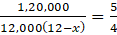
- Solving:
 months. B joined after 4 months.
8. The Difference Method
If you know the difference between two partners' shares and the ratio, you can find the total profit.
Example:
A and B invest in ratio 3 : 2. Total profit = Rs. 25,000.
Difference = 
If the difference is given as Rs. 6,000, then total profit =  .
.
9. Advanced Multi-Phase Problems
In mains-level exams, you'll see multiple changes in investments at different times. The approach is always the same: draw a timeline, break the time into segments, and compute total investment for each partner.
Example:
P, Q, R invest in ratio 1 : 2 : 3. After 4 months, Q doubles his investment and P withdraws half. After 8 more months, total profit = Rs. 21,000. Find shares.
- P:

- Q:

- R:

- Ratio =

- Total parts = 21
- P =

- Q =

- R =

10. Algebraic Relations in Partnership
Sometimes investments contain variables and you're given the profit ratio. Equate and derive relations.
Example:
M invests  for
for  months. N invests
  for months. O joins after
  months with 1.5 times M's initial investment. Profit ratio M : N : O = 4B : 8C : 5D.
- M's investment =

- N's investment =

- O's investment =

- Ratio =

- From M and O:

- So,
 is a true relation.
11. Average Capital and Profit Fractions
Average Capital:
If A contributes  of total capital, B contributes , and C contributes the rest. Profit = Rs. 9,000, which is 75% of B's capital. Find the average capital of A and C.
- Let total capital =
- B =


- A =

- C =

- Average of A and C =

Profit Fractions to Investment Ratio:
A gets of profit, B gets , C gets the rest. Time: A 6 months, B 8 months, C 9 months. C invests Rs. 15,000. Find A's investment.
- Profit ratio =

- C's investment =
 = 5 parts → 1 part = 27,000
 - A's investment =

12. Quick Formula Summary
|
Concept |
Formula |
|
Total Investment |
|
|
Profit Ratio |
|
|
Working Partner |
Deduct |
|
Charity |
Deduct |
|
Equal Share |
Each gets |
|
Interest on Capital |
Add to lender, subtract from payer |
|
Difference in Shares |
|
|
Find Total Profit |
|
|
Find Unknown |
Equate ratio parts to given share/difference |





Final Thoughts
Partnership problems are not about memorising 100 formulas. They're about adjusting first (salary, charity, equal share, interest) and breaking time whenever capital changes. Once you master these two habits, every question — from basic to mains — becomes a simple ratio problem.
Practice with different numbers, draw timelines, and always double-check whether you need to deduct something before applying the capital ratio. You've got this!
Login with