Mastering Ratio & Proportion: From Basic Balancing to Advanced Bank Exam Concepts
If you are preparing for competitive exams like Banking (IBPS, SBI, RRB), SSC, or CAT, you already know that Ratio & Proportion is not just a standalone topic. It is the backbone of Data Interpretation, Word Problems, Time-Speed-Distance, and Profit & Loss.
Many students try to memorize formulas, but the real trick is understanding the relationships between numbers. Today, I’m breaking down the complete advanced concepts of Ratio & Proportion, exactly as taught in Kaushik Mohanty’s comprehensive classes. We’ll walk through the golden rules, cross-product magic, and advanced problem-solving techniques, using fresh example questions to ensure you understand the core concepts inside and out.
Part 1: The Foundation – What Exactly is a Ratio?
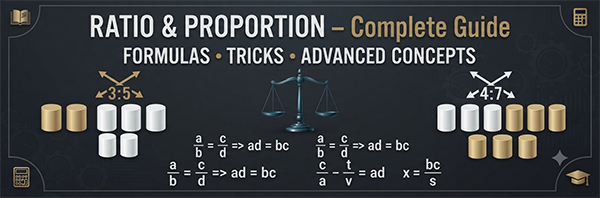
At its heart, a ratio is just a way to compare two or more quantities of the same kind. If I say the ratio of apples to oranges is 3:5, it means for every 3 apples, there are 5 oranges.
The Golden Rule of Variables:
If A : B = 3 : 5, never assume A is 3 and B is 5. Always assume A = 3x and B = 5x. This x is your "multiplier" that scales the ratio to real-world numbers.
Example: If the ratio of boys to girls in a class is 4:7, and the total number of students is 88, then 4x + 7x = 88 → 11x = 88 → x = 8. So, boys = 32, girls = 56.
Proportion & Continued Proportion
When two ratios are equal, they are in proportion. A : B :: C : D means A/B = C/D, which gives us the famous Cross Product Rule: A × D = B × C.
Continued Proportion: This happens when the middle terms are the same.
- 3 Terms: a : b :: b : c → b² = a × c (b is the mean proportional).
- 4 Terms: p : q :: r : s → p × s = q × r.
New Example: Find the mean proportional between 4 and 25.
- Let the mean proportional be x. So, 4 : x :: x : 25.
- x² = 4 × 25 = 100 → x = 10.
Types of Ratios (You must know these!)
Given a : b:
- Duplicate Ratio: a² : b²
- Sub-duplicate Ratio: √a : √b
- Triplicate Ratio: a³ : b³
- Sub-triplicate Ratio: ?a : ?b
- Compounded Ratio: Product of two ratios (a/b) × (c/d) = ac/bd
Part 2: The Golden Rules of Balancing (The Game Changer)
This is where 80% of exam questions come from. Balancing is used when a ratio changes due to addition, subtraction, or a constant value.
Golden Rule 1: One Variable is Constant
If the ratio of Milk to Water is 3:2, and after adding 4 liters of water, the ratio becomes 5:4. Here, the Milk is constant. We balance the milk values.
- Milk : Water = 3 : 2 (Multiply by 5 to make milk 15) → 15 : 10
- Milk : Water = 5 : 4 (Multiply by 3 to make milk 15) → 15 : 12
- The change in water is 12 - 10 = 2 parts.
- If 2 parts = 4 liters, then 1 part = 2 liters. Initial total = 15 + 10 = 25 parts = 50 liters.
Golden Rule 2: Difference is Constant
This is the hallmark of Age Problems. The difference between the ages of two people never changes.
New Example: 10 years ago, the ratio of ages of A and B was 5:3. 10 years from now, the ratio will be 3:2. Find their present ages.
- Let ages 10 years ago be 5x and 3x. Difference = 2x.
- Ages 10 years from now: 5x + 20 and 3x + 20. Difference remains 2x.
- New ratio: (5x + 20) / (3x + 20) = 3/2.
- Cross multiply: 10x + 40 = 9x + 60 → x = 20.
- Present ages: 5(20)+10 = 110 years, 3(20)+10 = 70 years.
Part 3: Business, Money, and Distribution
1. Profit, Capital, and Time
The golden formula for partnership is: Profit = Capital × Time.
If the profit ratio is P1 : P2, then P1 : P2 = C1 × T1 : C2 × T2.
New Example: X, Y, and Z start a business. Their capitals are in the ratio 3:4:5. Their profit ratio is 6:5:4. Find the ratio of their investment periods.
- Time = Profit / Capital.
- Time ratio = (6/3) : (5/4) : (4/5).
- LCM of 3, 4, 5 is 60. Multiply each by 60.
- Time ratio = 120 : 75 : 48 = 40 : 25 : 16.
2. Coin Problems (Number vs. Value)
The biggest trap in coin problems is confusing number of coins with value of coins.
Total Value = Number of Coins × Denomination.
New Example: A bag contains 1-rupee, 2-rupee, and 5-rupee coins in the ratio 3:4:5. The total value is Rs. 180. Find the number of 2-rupee coins.
- Let the number of coins be 3x, 4x, and 5x.
- Total Value = (3x × 1) + (4x × 2) + (5x × 5)
- 3x + 8x + 25x = 180 → 36x = 180 → x = 5.
- Number of 2-rupee coins = 4x = 20.
3. Income, Expenditure, and Savings (IES)
Always remember: Income = Expenditure + Savings. When dealing with percentages, convert them to fractions to simplify.
New Example: A's income is 25% more than B's. A's expenditure is 20% less than B's. If A saves Rs. 5000 and B saves Rs. 4000, find their incomes.
- Income ratio: A : B = 5 : 4.
- Expenditure ratio: A : B = 4 : 5.
- Let income be 5x, 4x. Let expenditure be 4y, 5y.
- 5x - 4y = 5000 and 4x - 5y = 4000.
- Solve the two equations: Multiply first by 5 and second by 4 → 25x - 20y = 25000 and 16x - 20y = 16000. Subtract → 9x = 9000 → x = 1000.
- A's income = 5x = Rs. 5000.
Part 4: Advanced Miscellaneous Concepts
1. The ax = by = cz Problem
When you see an equation like 4x = 5y = 6z, equate them to a constant k.
- x = k/4, y = k/5, z = k/6.
- Ratio x : y : z = 1/4 : 1/5 : 1/6.
- Multiply by LCM (60) → 15 : 12 : 10.
2. Direct and Indirect Variation (Weight and Cost)
If the cost of a diamond varies directly with the square of its weight: Cost ∝ (Weight)². If a diamond breaks, the sum of the values of the pieces is always less than the original value.
New Example: A diamond worth Rs. 81,000 breaks into pieces with weights in the ratio 1:2. What is the loss?
- Original weight = 1 + 2 = 3 units.
- Original Cost = k × (3)² = 9k = 81000 → k = 9000.
- Cost of pieces = k × (1² + 2²) = 9000 × 5 = 45000.
- Loss = 81000 - 45000 = Rs. 36,000.
3. The Chocolate Sharing Trick
This is a classic conceptual question. A, B, and C share chocolates. A has 6, B has 4, C has 0. They share equally, and C pays Rs. 20 for his share. How do A and B split the money?
- Total chocolates = 10. Equal share = 10/3 each.
- A gives 6 - 10/3 = 8/3. B gives 4 - 10/3 = 2/3.
- Ratio of chocolates given = 8/3 : 2/3 = 4 : 1.
- C pays Rs. 20 for the 10/3 he received. This money is distributed to A and B in the ratio 4:1.
- A gets (4/5) × 20 = Rs. 16. B gets (1/5) × 20 = Rs. 4.
Part 5: Advanced Data Sufficiency & Quantity Comparison
In advanced exams (like IBPS PO or SBI PO), you will face Quantity Comparison (Q1, Q2, Q3) or Data Sufficiency problems.
How to approach them:
- Solve Quantity I completely. Don't just look at it and assume. Find the exact numerical value.
- Solve Quantity II completely.
- Compare.
- For Data Sufficiency, solve step-by-step. Statement I alone might not be enough, but Statement I + II combined might give you the answer. Always check if the question can be solved using Statement I alone, II alone, or both together.
Example: What is the savings of Rohit?
- Statement I: Rohit spends Rs. 5,000 monthly.
- Statement II: Rohit's income is 20% more than his expenditure.
- Analysis: Statement I gives expenditure. Statement II gives income relative to expenditure. If you know expenditure is 5000 and income is 20% more, income = 6000. Savings = 6000 - 5000 = 1000. So, both statements together are sufficient.
Final Takeaways for Ratio & Proportion
- Don't assume numbers; use variables (x).
- Balancing is the key: If one thing is constant, make its parts equal. If the difference is constant, use the difference to equate.
- Break complex problems into equations. If A+B gets half of C+D, write it as an equation: C+D = 1/2(A+B).
- Convert percentages to fractions to make your calculations lightning-fast.
- Practice Data Sufficiency by solving both statements independently first.
Mastering these concepts will not only help you solve Ratio & Proportion questions but will also drastically improve your speed in Data Interpretation and Arithmetic Word Problems. Happy studying!
Login with