The Complete Guide to Average: From Basics to Advanced Concepts
Introduction
Average is one of the most fundamental concepts in quantitative aptitude, yet it's also one of the most powerful. Whether you're preparing for banking exams, CAT, or any competitive test, mastering averages can save you precious time and boost your accuracy. In this comprehensive guide, I'll walk you through everything from the basic formula to advanced problem-solving techniques, exactly as covered in my four-part series.
Let me take you through this journey step by step.
Part 1: The Foundation — What Is Average Really?
The Basic Formula
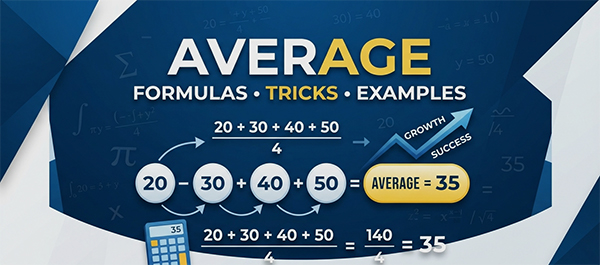
At its core, average is simply the sum of all values divided by the number of values:
Average = Sum / n
But here's what most people miss — the real power lies in rearranging this formula:
- Sum = Average × n
- n = Sum / Average
In my experience, the most important parameter in any average problem is the Sum. When you convert averages into sums, complex problems become surprisingly simple.
The Concept of "Per Head Value"
Think of average as what each person would get if everything were distributed equally. It's an imaginary equal distribution — a per-head value that represents the entire group.
Example: If 4 students score 36, 28, 54, and 42, the sum is 160, and the average is 40. This means if all students scored equally, each would have 40 marks.
Part 2: The Deviation Method — Your Speed Weapon
The deviation method is perhaps the most underutilized technique in average problems. Here's how it works:
The Core Idea
Instead of calculating with large numbers, use the old average as your base and work with deviations (differences).
For a new item added:
- If average increases by d, and the new total number is n, then:
- New item = Old Average + d × n
For replacement:
- New item = Replaced item + d × n
- Use plus if average increases, minus if it decreases.
Real Examples
Example 1: The Teacher Problem
43 students have an average weight of 37 kg. When the teacher joins, the average increases by 2 kg.
Old average = 37, new n = 44, increase = 2
Teacher's weight = 37 + 2 × 44 = 125 kg
Example 2: The New Member Problem
12 family members' average weight increases by 4 kg when a new member replaces someone weighing 52 kg.
New member = 52 + 4 × 12 = 100 kg
Example 3: The Batsman Problem
In his 18th inning, a batsman scores 84 runs, increasing his average by 3.
Old average = 84 − 18 × 3 = 30
New average = 33
Part 3: The Alligation Method — When Groups Mix
The Rule
When two groups with different averages combine, the alligation rule gives us the ratio of their quantities:
Quantity of Cheaper / Quantity of Dearer = (Dearer − Mean) / (Mean − Cheaper)
Understanding Through Example
The Classic Teacher Problem:
- Boys' average weight = 57 kg
- Teacher's weight = 109 kg
- New average = 61 kg
Using alligation:
Boys : Teacher = (109 − 61) : (61 − 57) = 48 : 4 = 12 : 1
So there are 12 boys. Simple, right?
The Salary Problem:
- 12 technicians have an average salary of ?14,900
- The rest have an average salary of ?6,100
- Overall average = ?9,300
Technicians : Rest = (9300 − 6100) : (14900 − 9300) = 3200 : 5600 = 4 : 7
So rest = 21, total = 33 workers
When to Use Alligation vs. Deviation
- Use Alligation when two averages and the overall average are given.
- Use Deviation when the average changes by a small amount.
Part 4: Arithmetic Progression in Average
The Middle Term Magic
In an arithmetic progression (AP):
- For odd number of terms: Average = Middle term
- For even number of terms: Average = Average of two middle terms
The Formula
For consecutive numbers or multiples:
Average = (First + Last) / 2
Examples
Example 1: Odd Terms
9 consecutive multiples of 13 have an average of 12,831.
- Middle (5th) term = 12,831
- 3rd largest = 7th term = 12,831 + 2 × 13 = 12,857
Example 2: Even Terms
8 consecutive multiples of 11 have an average of 10,862.5.
- Second smallest = 10,862.5 − 2.5 × 11 = 10,835
Part 5: Miscellaneous Concepts You Must Know
1. Change in Every Term
If every number is changed by the same operation:
- +k to each term → New Average = Old Average + k
- −k from each term → New Average = Old Average − k
- ×k to each term → New Average = Old Average × k
- ÷k to each term → New Average = Old Average ÷ k
General: Each term → a × term + b
New Average = a × Old Average + b
2. Same Number Subtracted from All
If k is subtracted from each of n numbers:
n(a − k) = New Sum
3. Percentage-wise Changes
Net change = sum of weighted changes.
Example: 75% numbers increased by 4, 25% decreased by 8.
Change = (3/4)(+4) + (1/4)(−8) = 3 − 2 = +1
Old average = 46 → New average = 47
4. Replacement Problems
Change in average = (New value − Replaced value) / n
- If average increases by 1 when a is replaced by x: x − a = n
- If average decreases by 1 when b is replaced by x: x − b = −n
- Then difference b − a = 2n
5. Digit Reversal
Two-digit number 10x + y reversed to 10y + x
Difference = 9(x − y)
If average of n numbers decreases by d:
|x − y| = nd / 9
6. New Members Joining/Leaving
Use: Old Sum + New Sum = New n × New Average
Part 6: Advanced Problem-Solving Techniques
1. Data Sufficiency Strategy
Combine statements to get the ratio of groups using alligation.
Example: Boys average = 240, Girls average = 180. If each boy eats 10, overall average = 200.
Let boys = B, girls = G
(230B + 180G) / (B + G) = 200
30B = 20G
B : G = 2 : 3
So girls percentage can be found — both statements needed.
2. Ratio + Correction of Recorded Values
Example: Recorded ratio = (x+7) : x : (x−1), average = 56.
x = product of two primes whose difference is neither prime nor composite → primes 2 and 3 → x = 6.
Ratio = 13 : 6 : 5, total recorded sum = 168.
Recorded: 91, 42, 35.
Corrections:
- Akash recorded 44.44% more → actual = 91 × 9/13 = 63
- Aman recorded 14.28% less → actual = 42 × 7/6 = 49
- Aniket recorded 33 kg more → actual = 35 − 33 = 2
Original average = (63 + 49 + 2) / 3 = 38 kg
3. AP & GP Together
Example: AP of 4 numbers, common difference 4.
Let AP = a−6, a−2, a+2, a+6, average = a.
GP 5 terms: x, xr, xr², xr³, xr?.
Half of 3rd highest = average AP → xr²/2 = a.
Lowest AP = second lowest GP − 6 → a−6 = xr−6 → xr = a.
Difference between 2nd largest and smallest GP = 133 → xr³ − x = 133.
Solve: r = 2, x = 19, a = 38.
AP sum = 4a = 4 × 38 = 152
Part 7: Quick Formula Reference
|
Concept |
Formula |
|
Basic Average |
Sum / n |
|
Sum |
Average × n |
|
New item (avg +d) |
Old Avg + d × n |
|
Replacement |
Replaced item ± d × n |
|
Alligation ratio |
(Dearer − Mean) : (Mean − Cheaper) |
|
AP average (odd) |
Middle term |
|
AP average (even) |
Avg of two middle terms |
|
Consecutive numbers |
(First + Last) / 2 |
|
Change in every term |
a × Old Avg + b |
|
Digit reversal |
9 × digit difference |
Part 8: Exam Tips & Strategies
- Convert averages to sums — it simplifies most problems.
- Use alligation when two group averages and overall average are known.
- Use deviation when average changes by a small amount.
- For AP/consecutive problems, always locate the middle term first.
- For even count, average lies exactly between the two middle terms.
- In data sufficiency, check if ratio + one count can give total.
- Track sum change when terms are added, removed, or replaced.
- For age problems, add years to old members before mixing.
- Practice replacement problems — they appear frequently.
- Remember: Average is just a per-head value; think of it as equal distribution.
Conclusion
Average is a topic that rewards understanding over memorization. Once you grasp the core idea — that average is simply a per-head value derived from the sum — you can tackle any problem with confidence.
The key is to:
- Convert to sums whenever possible
- Use deviation for speed
- Apply alligation for group mixing
- Locate the middle in AP problems
- Track changes systematically
Practice these concepts with the examples I've shared, and you'll find that even the most complex average problems become manageable.
Happy learning!
Login with