

Introductory concepts in weather including the atmosphere and its layers, temperature and the factors affecting it, atmospheric pressure and winds, humidity and dew point, cloud types, forms of precipitation, air masses and fronts, cyclones and anticyclones, seasons, weather forecasting and instruments, and the difference between weather and climate.
Weather appears to be a random mix of sunshine, rain, wind and fog. But every drop of rain, every gust of wind and every cloudy afternoon follows a set of physical rules. Weather is simply the condition of the atmosphere at a particular place at a particular time. It is what you experience when you step outside in the morning — hot or cold, dry or humid, calm or windy, clear or overcast.
In this way, weather is the short-term behaviour of the air around us. Weather is about temperature, pressure, moisture, wind and the clouds that form when these elements interact. It is not random — it is the result of energy from the Sun moving through the atmosphere.
What Is Weather?
Weather is the state of the atmosphere at a given place and time, described by elements such as temperature, atmospheric pressure, humidity, wind, cloud cover and precipitation. These elements change from hour to hour and from day to day, which is why a weather report becomes outdated so quickly.
For instance, a city may wake up to a cool, clear morning, experience a hot and humid afternoon, and end the day with a thunderstorm. All of this is weather. The five basic questions in weather study are: How hot or cold is the air? How heavy is the air? How much moisture does it hold? How is the air moving? What is the air producing — clouds, rain or nothing at all?
The study of weather is broken into two broad areas: weather observation and weather forecasting.
Weather Observation: This involves measuring the elements of the atmosphere using instruments — thermometers for temperature, barometers for pressure, hygrometers for humidity, anemometers for wind speed and rain gauges for rainfall. These measurements are taken at weather stations on land, on ships at sea, by weather balloons and by satellites.
Weather Forecasting: This involves using the observed data, along with computer models of the atmosphere, to predict what the weather will be in the coming hours and days. Forecasts of interest to the public include rainfall, temperature range, wind speed, humidity levels and warnings of storms.
Weather vs Climate
Weather and climate are often confused, but they operate on different time scales. Weather is what happens over hours or days; climate is the average pattern over many years.
| Basis | Weather | Climate |
|---|---|---|
| Time span | Short term — hours to days | Long term — 30 years or more |
| Nature | Changing and dynamic | Average and stable |
| Example | "It rained heavily in Mumbai today." | "Mumbai receives heavy monsoon rainfall." |
| Study | Meteorology | Climatology |
Layers of the Atmosphere
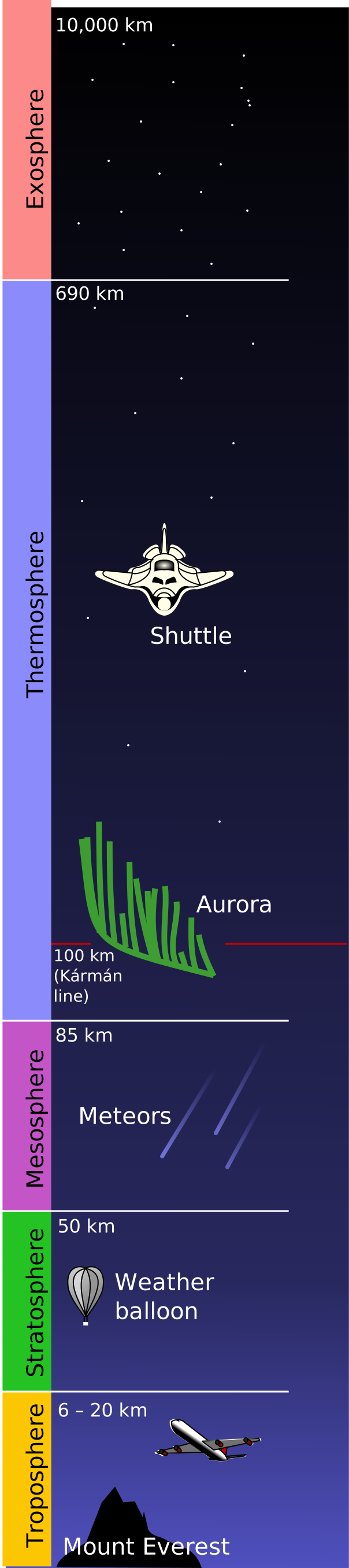
All weather takes place in the atmosphere, but not in all of it. The atmosphere is divided into layers based on how temperature changes with height.
- Troposphere: The lowest layer, where all weather occurs. Temperature decreases with height. It contains most of the atmosphere's water vapour and dust.
- Stratosphere: Contains the ozone layer, which absorbs harmful ultraviolet radiation. Temperature increases with height here, and the air is very stable — jet aircraft often fly in this layer.
- Mesosphere: Temperature falls again with height. Most meteors burn up in this layer.
- Thermosphere: Temperature rises sharply. This layer contains the ionosphere, which helps in radio communication and produces auroras.
- Exosphere: The outermost layer, where the atmosphere gradually fades into space.
Temperature and Its Factors
Temperature is the degree of hotness or coldness of the air. It is driven mainly by insolation — the incoming solar radiation received at the Earth's surface. However, the same amount of sunlight does not produce the same temperature everywhere.
- Latitude: Sunlight falls more directly near the equator and more obliquely near the poles, so temperatures generally fall from the equator towards the poles.
- Altitude: Temperature decreases with height in the troposphere, which is why hill stations are cooler than plains at the same latitude.
- Distance from the sea: Coastal areas have a moderate climate, while inland areas have extreme summers and winters.
- Ocean currents: Warm currents raise the temperature of nearby coasts, while cold currents lower it.
- Vegetation and land cover: Forests and vegetation moderate temperature, while bare surfaces heat up and cool down rapidly.
- Cloud cover: Clouds reduce daytime heating and slow down nighttime cooling.
Atmospheric Pressure and Winds
Atmospheric Pressure: The weight of the air column above a point. Pressure decreases with altitude and varies with temperature. Warm air expands and becomes lighter (low pressure), while cold air contracts and becomes heavier (high pressure).
Winds: Air always moves from a region of high pressure to a region of low pressure. This moving air is wind. The greater the pressure difference, the stronger the wind. Wind direction is deflected by the Coriolis force caused by the Earth's rotation.
- Planetary winds: Trade winds, westerlies and polar easterlies, which blow over large belts of the Earth.
- Monsoon winds: Seasonal winds that reverse direction between summer and winter. India's summer monsoon brings moist air from the sea.
- Local winds: Sea breeze and land breeze along coasts, and mountain and valley breezes in hilly regions.
High pressure → air moves outward → fair, stable weather
Low pressure → air moves inward → clouds, rain, unsettled weather
Humidity and Dew Point
Humidity: The amount of water vapour present in the air. Absolute humidity measures the actual mass of vapour, while relative humidity compares the vapour present to the maximum the air could hold at that temperature.
Dew Point: The temperature at which air becomes saturated and water vapour begins to condense into liquid droplets. If the air cools below its dew point near the ground, dew or fog forms; if it happens higher up, clouds form.
Warm air can hold more moisture than cold air. This is why a hot and humid day feels suffocating, and why cooling air at night often produces dew on grass in the morning.
Clouds and Their Types

Clouds form when rising air cools to its dew point and water vapour condenses around tiny particles called condensation nuclei.
- Cirrus: Thin, wispy, high-altitude clouds made of ice crystals. They usually indicate fair weather but can signal an approaching change.
- Cumulus: Puffy, cotton-like clouds with flat bases. Small cumulus mean fair weather; large cumulus can grow into storm clouds.
- Stratus: Low, flat, layered clouds that spread across the sky and often produce drizzle or a grey overcast day.
- Nimbus: Dark clouds associated with rain. Cumulonimbus are towering storm clouds that produce thunderstorms, heavy rain, hail and lightning.
- Cirrostratus: A thin veil of high cloud that often produces a halo around the Sun or Moon.
Forms of Precipitation

- Rain: Liquid water droplets falling from clouds.
- Snow: Ice crystals that fall when the air is below freezing throughout the cloud.
- Sleet: A mixture of rain and snow.
- Hail: Balls of ice formed in strong thunderstorm updrafts.
- Drizzle: Very fine droplets falling from low stratus clouds.
Air Masses and Fronts

Air Mass: A large body of air with fairly uniform temperature and humidity, formed over a region such as a warm ocean or a cold continent.
Front: The boundary where two different air masses meet. Fronts are a major cause of weather changes.
- Warm front: Warm air rises over cold air, producing gentle, prolonged rain.
- Cold front: Cold air pushes under warm air, producing short, heavy rain and thunderstorms.
- Occluded front: A cold front catches up with a warm front, often producing complex and prolonged rainfall.
Cyclones and Anticyclones

Cyclone: A region of low pressure with winds spiralling inward. Cyclones bring clouds, rain and unsettled weather. In the Northern Hemisphere, winds blow anticlockwise; in the Southern Hemisphere, clockwise.
Anticyclone: A region of high pressure with winds spiralling outward. Anticyclones bring clear skies, calm winds and stable weather — often dry and sunny, or foggy in winter.
Seasons
Seasons occur mainly because the Earth's axis is tilted as it orbits the Sun. This tilt changes the angle at which sunlight strikes different parts of the Earth throughout the year, producing summer, autumn, winter and spring in the mid-latitudes. Near the equator, seasons are marked more by rainfall patterns than by temperature.
Weather Instruments and Forecasting
- Thermometer: Measures temperature.
- Barometer: Measures atmospheric pressure.
- Hygrometer: Measures humidity.
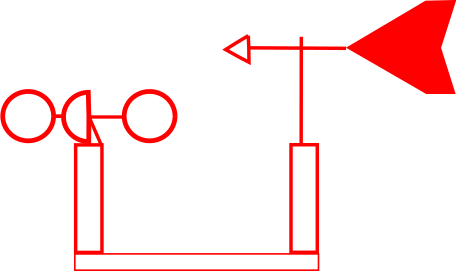
- Anemometer: Measures wind speed.
- Wind vane: Shows wind direction.
- Rain gauge: Measures rainfall.
- Radar and satellites: Track clouds, storms and rainfall over large areas.
Modern forecasting combines ground observations, weather balloons, aircraft data, satellites and radar with powerful computer models that simulate the atmosphere. The accuracy of forecasts generally decreases with time — a forecast for tomorrow is far more reliable than a forecast for next week.
Weather is what you get; climate is what you expect.
Understanding weather matters because it affects agriculture, transport, aviation, health, water supply and disaster management. A well-timed forecast can save a harvest, ground a flight safely or warn a coastal town before a cyclone arrives.
Login with